Franchise Fixation: Halloween II (1981)
The night he came home isn't over yet, but three years later, horror had already changed.

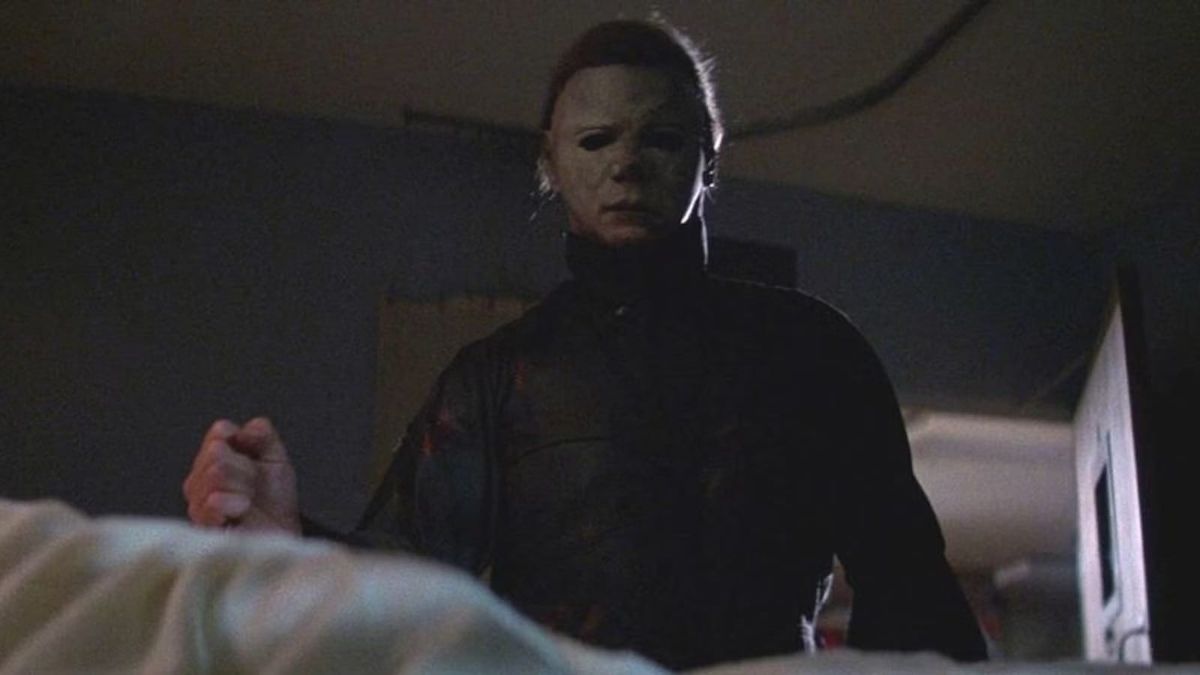
Halloween didn't need a sequel.
That's probably not the best way to begin an article about Halloween II, especially when there are eleven more movies waiting for me after this one, but here we are.
The original Halloween ends about as perfectly as a horror movie can. Dr. Loomis shoots Michael Myers six times, Michael falls from the second-story balcony, and when Loomis looks down, he's gone. Carpenter then cuts between the empty places we've spent the movie visiting while Michael's breathing continues over the soundtrack. The Boogeyman could be anywhere.
Cut to black.
You can leave the story there forever.
Or, apparently, you can wait three years and immediately pick up about thirty seconds before it ended.
More of the Night He Came Home
Halloween II opens by replaying the first movie's climax. These “previously on” segments were also popular in the first few Friday the 13th sequels; the first of those sequels also came out in 1981, and this is only one of a handful of reasons Halloween II feels more like a Friday the 13th sequel than a sequel to Halloween. Regardless, we again see Laurie (Jamie Lee Curtis) telling Tommy and Lindsey to run to the neighbors while Michael gets back up and tries to kill her one more time. Loomis (Donald Pleasance) arrives, shoots him repeatedly, and sends him over the balcony.
Right off that finale, Loomis runs outside. There's blood on the lawn. No Michael. A neighbor wanders over wearing a bathrobe and asks what's going on, and explains he’s been “trick-or-treated to death.” "You don't know what death is," Loomis tells him with all the restraint we've come to expect from Dr. Samuel Loomis, before running off into the night.
Cue the main Halloween theme and the opening credits.
There's something genuinely clever about the way Halloween II announces what it's going to be during its opening credits. The original Halloween begins with that wonderfully simple shot of a glowing jack-o'-lantern as Carpenter's theme plays. Halloween II recreates the image, except this time the pumpkin slowly splits open to reveal a skull hiding inside. It’s as if the movie is telling us, “It's Halloween, but now we're going to show you the gruesome stuff.”
By the time Halloween II arrived in theaters on October 30, 1981, the horror landscape had already changed dramatically from what Carpenter's film had entered three years earlier. Friday the 13th arrived in 1980, followed by the already mentioned Friday the 13th Part 2 earlier in ‘81, and the slasher boom was well underway. Saying “the slasher boom was well underway” might be putting it lightly. Depending on your source, 30 to 42 slasher films were released in 1981 alone, including Happy Birthday to Me, My Bloody Valentine, The Prowler, Hell Night, Final Exam, and The Burning. And it wasn’t just slashers getting the limelight; horror, in general, was in full bloom. Two of the most beloved Werewolf movies, An American Werewolf in London and The Howling, were both released, along with another werewolf feature, Wolfen. 1981 also gave us David Cronenberg’s Scanners, Lucio Fulci’s The Beyond, and a truly underrated masterpiece, Gary Sherman’s Dead & Buried. All this to say, horror was in fashion in a way it probably hadn’t been since the heyday of the classic Universal horror cycle, at least in the US. I try to avoid upsetting the dedicated fanbase of the Hammer Studio offerings that dominated the UK (and sometimes US) scene starting in the late 1950’s, because I too am one of them.
Halloween II had considerably more money to work with—the reported budget was around $2.5 million, compared with roughly $320,000 for the original—and a major studio, Universal, was distributing it. It ultimately grossed about $25.5 million domestically. But the bigger difference may have been that the people behind Halloween didn't seem particularly convinced there should be a Halloween II in the first place.
John Carpenter and Debra Hill returned to write and produce, but Carpenter had no interest in directing another one. His explanation years later was wonderfully simple: he'd already made that movie once. Rick Rosenthal, making his feature-directing debut, got the unenviable job of following him.
Carpenter didn't exactly find writing it any easier. Years later, he described sitting at the typewriter with a six-pack of beer because he couldn't figure out where the story was supposed to go. In his mind, he'd used his ideas in the first film. Michael Myers wasn't supposed to have an elaborate motivation waiting to be uncovered in Part II. He was the Shape.
Now somebody decided the world needed another 90 minutes of Michael Myers slashing his way through Haddonfield. Which, when you think about it, is the fundamental problem Halloween II spends its entire running time trying to solve.
Halloween Night Isn't Over Yet
The solution Carpenter and Hill eventually landed on was, at the time, an unusual one for a sequel: don't move forward at all. Halloween II takes place on the same night as Halloween, beginning moments after the original ends and eventually carrying the story into the morning of November 1. At this point in the franchise, it's the only entry that lets us see Halloween night turn into the next morning.
Apparently, that wasn't always the plan.
One early concept would have jumped ahead a few years and found Laurie living as a fearful recluse in a heavily secured high-rise apartment building when Michael returned. The idea never became the movie, but it's fascinating in hindsight because this sounds very similar to a version of Laurie we'd eventually meet anyway. Both Halloween H20 and especially Halloween (2018) give us older Lauries whose lives have been permanently reshaped by what happened in 1978. The latter takes that idea to its extreme, turning Laurie into a loner survivalist who's spent decades preparing for the possibility that Michael might return.
Instead, Halloween II makes the much stranger decision to keep Laurie exactly where we left her chronologically while completely changing her surroundings. She's taken to Haddonfield Memorial Hospital, which may be the least adequately staffed medical facility in Illinois. There are a handful of nurses, one doctor, a security guard, and a couple of paramedics. We do see babies sleeping in the maternity ward. What we don't seem to have are many actual patients, or the mothers of those babies. Maybe they're all sleeping peacefully somewhere off-camera while Michael Myers murders his way through the night staff. I certainly hope so, because otherwise there will be some very confused newborns on the morning of November 1.
The emptiness does give Rosenthal a potentially great setting. Long sterile hallways, darkened rooms, fluorescent lights, and empty nursing stations should be perfect places for Michael Myers to disappear into the background. And sometimes they are. Rosenthal repeatedly tries to recreate Carpenter's trick of letting us see Michael when the characters don't. He'll appear at the end of a hallway or materialize in the background, and cinematographer Dean Cundey—returning from the first film—helps make Halloween II look enough like its predecessor that the two movies can plausibly occupy the same night despite being shot three years apart.
But something is different.
The original Halloween made Michael's presence in the background unnerving because we were constantly waiting for him to do something. Halloween II often feels like it's waiting too. And when it finally does something, it's usually a lot messier.
Halloween Gets Bloodier
The added gore is probably the biggest difference, at least aesthetically, between Halloween and Halloween II. The original movie certainly isn't bloodless, and it’s definitely violent, but Carpenter rarely seemed particularly interested in showing us what Michael Myers was doing to people. Bob gets pinned to a wall with a kitchen knife, but even that is more about the bizarre image of Michael tilting his head and admiring his work than watching the knife go in. Annie is strangled and has her throat cut inside the car, but the actual violence is brief. Lynda is strangled with a telephone cord.
Halloween II, meanwhile, has Michael plunge a hammer into the top of a security guard's skull, drown a nurse in scalding water until the skin peels from her face, and stick a hypodermic needle directly into someone's eyeball. Welcome to the 1980s. Part of that escalation feels inevitable. As I mentioned earlier, Halloween II arrived after Friday the 13th and Friday the 13th Part 2, along with a wave of slasher movies that took Carpenter's basic template and added increasingly elaborate ways to kill teenagers. By 1981, simply having Michael strangle someone with a telephone cord probably wasn't going to cut it anymore. The strange thing is that Halloween II never seems entirely comfortable becoming that kind of movie.
Rick Rosenthal, as I mentioned before, was a first-time feature director when he was handed the Halloween II assignment, and much of the movie seems determined to preserve the original's visual language. Michael appears in the background. He moves slowly through the frame. And it can’t be said enough how important it was for Dean Cundey to return as cinematographer, giving the movie enough of the same visual texture that you can almost convince yourself these events really are happening only minutes after the first movie ended. Then somebody gets a syringe shoved through their eye. Fun.
This movie has an obvious push and pull that became even more complicated after filming. Carpenter and Universal were both unhappy with Rosenthal's cut, which Carpenter felt simply wasn't scary enough. As one of the film's producers, Carpenter went back into the editing room to tighten the movie and eventually shot additional material intended to make it faster and more frightening. Dick Warlock's son Lance, for example, plays the kid carrying a boombox who bumps into Michael on the street, and the official Halloween site credits Carpenter with directing that scene.
So, where Rosenthal's Halloween II ends and Carpenter's version begins isn't always obvious while you're watching. What is obvious is that the finished film is trying to satisfy two somewhat incompatible impulses: recreate the slow-burn suspense of Halloween while also giving a 1981 slasher audience the more explicit violence it had come to expect. For me, neither side ever completely wins.
And the problem isn't that I object to gore. I've watched enough horror movies in my life that a little melted face won't send me running for the exits. The problem is that most of the kills in Halloween II aren't particularly interesting to me. Karen's (Pamela Susan Shoop) death is certainly memorable. Michael grabs her from behind in the hospital's therapy room and repeatedly dunks her face into a hot tub that's apparently been turned up to approximately the temperature of the surface of the sun. Each time he pulls her back up, more of her face has been burned away. It's an image that's difficult to forget, although apparently the scene wasn't much fun to make either. Pamela Susan Shoop later said it took two days to film and involved extensive discussion over what she was comfortable showing on camera. She also remembered spending a considerable amount of time submerged in cold, dirty water while Dick Warlock took particular care to make sure she felt safe.
It's certainly more graphic than anything Carpenter showed us in the original. I'm just not convinced it's scarier.
That's the distinction I keep coming back to with Halloween II. The first movie spends so much time making us wonder where Michael is that his eventual attacks feel like the release of tension that's been building for minutes (and feels like hours). The sequel frequently seems more interested in the payoff than the buildup.
Nurse Janet's (Ana Alicia) death is probably the best example. Rosenthal stages another variation on one of the original movie's most famous images, allowing Michael to emerge from the darkness behind her. It's a great visual. The problem is that we've barely had time to care about Janet before Michael sticks a syringe into her temple. It's a striking death. It's just not particularly frightening.
Even stranger, Halloween II can't decide how much it wants to indulge in this stuff. Karen gets the elaborate hot-tub treatment. Janet gets the syringe. Mr. Garrett (Cliff Emmich) gets a hammer to the skull. But Dr. Mixter (Ford Rainey) is simply discovered dead in his chair, and Mrs. Alves (Gloria Gifford) gets one of the movie's more gruesome deaths — drained of her blood through an IV — without us seeing Michael actually kill her or how in the hell he even set all that up. It’s as confusing as trying to figure out how John Kramer sets up the “Bedroom Trap” in Saw IV. If you know, you know (for the record, if you don’t know, I wouldn’t go out of my way seeking an answer).
Despite Halloween II’s inability to commit to how graphic or suspenseful it wants to be, this movie understands one thing very well, and that’s the town itself.
Haddonfield Is Having a Very Bad Night
One of my favorite things about Halloween II is that it actually lets us see what happens when the events of the first movie stop being Laurie's nightmare and become Haddonfield's problem.
Police cars are everywhere. Neighbors are wandering outside. News crews have arrived. People gather around the Myers house, and at one point are seen throwing rocks and other things at it, as if we just wandered onto the set of a modern-day Frankenstein where the local villagers are letting the Dr. know how they feel about his creation; in this case, instead of Frankenstein, it’s Loomis, but you get the idea. Word is spreading that several teenagers have been murdered. And somewhere in the middle of all of this, Dana Carvey is hanging around. Yes, that Dana Carvey.
The movie also gives us one of the strangest little snapshots of what Halloween actually felt like in the early 1980s. A mother arrives at the hospital with her young son, who has a razor blade stuck in his mouth after biting into a piece of candy. Nothing ever comes of it. The kid isn't connected to Michael. He doesn't become part of the story. He exists almost entirely as background detail. But in 1981, audiences knew exactly what that meant. Fear over poisoned or tampered Halloween candy had been circulating for years, and stories about razor blades hidden inside apples became part of the annual Halloween ritual. The panic became widespread enough that hospitals were offering to X-ray children's candy for metal objects. Contemporary reporting from 1982 describes hospitals providing those screenings free of charge. The actual threat was wildly disproportionate to the fear surrounding it, but the fear itself was very real.
So, this random kid sitting in Haddonfield Memorial with a razor blade in his mouth is doing something Halloween II does surprisingly well: making the movie feel like it's taking place on Halloween rather than merely on October 31st.
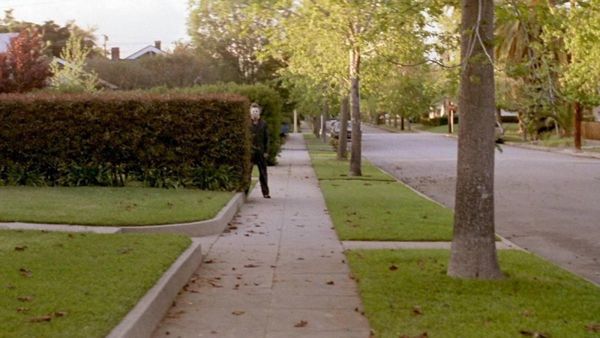
And then there's Ben Tramer. Poor, poor Ben Tramer, or Bennet Tramer, as his concerned friends later call him. If you remember the original Halloween, Ben is the boy Laurie has a crush on—the one Annie spends a portion of the movie trying to set her up with. He never actually appears. Halloween II finally lets us meet him; sort of. While Loomis and the police search Haddonfield, they spot someone in a white mask and dark clothing walking down the street. Loomis immediately assumes it's Michael and charges toward him with a gun. The masked figure backs into the road. A police car hits him. The police car then smashes into another vehicle and explodes. So, after Laurie spends the entire first movie hoping she might finally get to go out with Ben Tramer, he apparently spends Halloween night wandering around town dressed up just enough like Michael Myers to get hit by a police car, crushed against a van, and burned beyond recognition. Happy Halloween, Ben.
Meanwhile, Laurie Takes a Nap
Starting Halloween II immediately after the original gives the movie one major advantage: it really does feel like we're watching the second half of the same terrible night. It also creates a pretty serious Laurie Strode problem. At the end of Halloween, Laurie has been strangled, thrown down a staircase, cut with a knife, chased through multiple houses, and attacked repeatedly by a man who apparently doesn't understand the generally accepted medical consequences of being stabbed, poked in the eye with a coat hanger, or shot six times. Naturally, Halloween II sends her to the hospital. Realistically, that's exactly where she should be. Dramatically, it's a disaster.
For a substantial portion of her own sequel, Laurie is lying in a hospital bed, injured, traumatized, and increasingly drugged. She even begs the hospital staff not to put her to sleep, which is probably reasonable considering how her evening has been going. Weirdly, the franchise doesn’t learn its lesson and does almost the exact same thing to the character in 2021’s Halloween Kills. Jamie Lee Curtis still does a lot with very little. Laurie's vulnerability makes sense after what she's just survived, and Curtis keeps her feeling like the same person despite far less dialogue and spending so much of the movie barely conscious.
But the larger problem remains: Halloween had Laurie Strode, the bad-ass final girl. Halloween II has Laurie Strode simply lying down. Normally, a slasher sequel could compensate by giving us another character to follow until the returning heroine gets back into the action. Halloween II never really finds one. The closest thing we get is Jimmy.
Jimmy (Lance Guest) is one of the paramedics who brings Laurie into Haddonfield Memorial, and he takes an almost immediate interest in her. Lance Guest is likable enough in the role, and Jimmy is clearly intended to be the sweet guy we're supposed to root for. I've just always found the whole thing a little strange. Laurie is a high-school student who has just watched several of her friends get murdered and arrived at the hospital injured and traumatized. Jimmy appears to be an adult—at the very least old enough to be working as an ambulance attendant—and at one point explains that his younger sister goes to school with Laurie. And within what seems like minutes of Laurie's arrival, he's already hovering around her room like a lovesick puppy.
The bigger issue isn't even Jimmy's questionable bedside flirting. It's that he never becomes a strong enough character to take over the movie while Laurie is incapacitated. Neither does Karen. Neither does Budd (Leo Rossi). Neither does Mrs. Alves. The hospital staff mostly exists as a collection of people Michael can eventually work his way through.
They're, to put it frankly, a strangely understaffed, sexually active, occasionally drunk slasher buffet. Which leaves Halloween II without the thing that made the original work so well: someone we're really following. Fortunately, it still has Donald Pleasence. And Dr. Loomis is about to become extremely Dr. Loomis.
Dr. Loomis Would Like to Prescribe Even More Bullets
If Laurie spends much of Halloween II sidelined, Loomis gets the opposite treatment. The man who spent the first movie desperately trying to convince everyone that Michael was dangerous has now been proven spectacularly correct, and he responds to that validation exactly as you might expect: by becoming even more intense. At one point, Sheriff Brackett (Charles Cyphers) discovers that his daughter Annie was one of Michael's victims, understandably abandons the search, and leaves Deputy Gary Hunt (Hunter von Leer) in charge. Loomis continues racing around Haddonfield warning anyone who will listen that Michael isn't a man in any meaningful sense of the word.
And I love him for it.
Pleasence could have easily turned Loomis into a caricature here, and maybe he occasionally comes close, but there's something wonderfully entertaining about watching this increasingly frantic psychiatrist realize that shooting his patient several times has accomplished absolutely nothing. He spent the entire first movie telling people Michael was pure evil. Now Michael has survived half a dozen bullets and disappeared into the night, so from Loomis's perspective, everything he believed has been confirmed.
The movie also starts nudging Loomis—and us—toward an explanation for Michael that I'm not sure we ever needed. In a scene where Loomis and the police investigate an elementary school Michael had broken into earlier, Loomis discovers the word "Samhain" written in blood on a chalkboard. He launches into a history lesson about the ancient festival, sacrifices, and the origins of Halloween, because apparently this is also the night Dr. Loomis decided to teach an introductory Celtic studies course.
Side note, but I’ve always found the school scene strange. When exactly did Michael go to the school? Why did he go there? Why did he write Samhain on the board? There's also a child's drawing with a knife stabbed through the figure of a sister. Is Michael leaving clues for Loomis now? Does he want someone to figure it all out? Did he take a break from murdering people to create a themed scavenger hunt?
The Samhain material would eventually become much more important to this franchise, especially once we get to Halloween: The Curse of Michael Myers. Here, though, it feels like Halloween II reaching for mythology without really knowing what it wants that mythology to mean. I haven't found reliable evidence that there was originally a substantially larger Samhain storyline that Carpenter later cut, so as intriguing as that possibility is, I wouldn't present it as anything more than speculation.
The funny part is that Loomis doesn't really need to solve the mystery at the school anyway, because Marion Chambers (Nancy Stephens) is on her way back into the story with the answer.
Michael Myers Has a Sister
Marion, who had the unfortunate job of riding with Loomis when Michael escaped Smith's Grove in the first movie, arrives with U.S. Marshal Terrence Gummell (John Zenda) under orders to get Loomis out of Haddonfield. While they're driving, she reveals information from Michael's sealed records: two years after Judith Myers was murdered, Michael's parents died, and their younger daughter was adopted by the Strodes.
Laurie is Michael's sister.
This is probably the most consequential decision Halloween II makes. Michael Myers went from being a killer who fixated on Laurie, seemingly because she happened to walk up to his childhood home at the wrong time, to a man hunting his younger sister. That single revelation became the foundation for most of the franchise that followed. Halloween 4, 5, The Curse of Michael Myers, H20, and Resurrection all exist in a continuity where Michael's murderous interest in his family is fundamental to the character. Rob Zombie keeps this plotline alive for his two entries as well. The 2018 Halloween eventually had to erase this movie altogether to get rid of it.
And John Carpenter has never exactly sounded proud of the idea.
Carpenter has explained that the sibling reveal came from the basic problem we've been talking about since the beginning of this review: he didn't believe much story remained after Halloween. He needed a reason for Michael to continue pursuing Laurie, and making them siblings gave him one. Years later, Carpenter was considerably less diplomatic, calling the idea "terrible" and "stupid."
I actually don't hate it.
Would I put it in the original Halloween? Absolutely not. Part of what makes that movie frightening is that Laurie hasn't secretly done anything to attract Michael's attention. She walks up to the Myers house to drop off a key; he sees her, and that's essentially it. There's no grand destiny involved. She was simply there. Halloween II changes that, and I understand why people think the revelation makes Michael less frightening. Once you give evil a reason, even a vague one, you've made it a little easier to understand. But Halloween already exists. Nothing Halloween II reveals can change how the original movie plays for me. Michael doesn't know he's Laurie's brother because of some secret clue hidden in the first film; Carpenter and Debra Hill hadn't conceived of that relationship yet. If I want Michael to remain the Shape with no meaningful motivation, I can watch Halloween and stop when the credits roll.
Halloween II, however, needs a reason for him to walk across Haddonfield, ignore countless potential victims, and eventually show up at Laurie's hospital. Making her his sister is certainly a reason. Maybe not a great one, but it's a reason. And once Loomis learns the truth, Donald Pleasence gets another wonderfully unhinged moment. He pulls a gun on Gummell inside the marshal's car and forces him to turn around and head toward Haddonfield Memorial. Marion has to assure Gummell that Loomis is actually a doctor, which might be the least convincing argument anyone could make while the doctor in question is holding a revolver on a federal marshal. Again: extremely Dr. Loomis. And again: extremely entertaining.
How Did Michael Even Get Here?
The sibling reveal solves one problem while creating another. Michael now has a reason to find Laurie, but how exactly does he know where she is?
The movie does answer that, though it's easy to miss. During one of the additional scenes Carpenter shot, Michael bumps into that kid we mentioned earlier carrying a portable radio. A news report mentions the murders and says Laurie has been taken to Haddonfield Memorial Hospital. That gives Michael the information he needs to start making his way there.
What I find more interesting is what Michael does after he learns it. He walks. A lot. And apparently nobody else in Haddonfield is worth the time or trouble for his Halloween night mass-murdering spree. This is where the sister revelation changes the way Michael behaves in a way that bothers me more than the revelation itself. Earlier in the movie, he wanders into the home of Alice (Anne Bruner) and kills her despite having no apparent connection to her. But once he knows Laurie is at the hospital, he becomes remarkably focused. He passes through Haddonfield surrounded by potential victims and just keeps going.
The Michael Myers of the original movie had an eerie curiosity about people. He watched Laurie from across the street. He followed Annie and Lynda. He moved bodies around and staged them for Laurie to discover. There was something almost playful about him, although "playful" feels like a strange word to use for a guy murdering teenagers. Dick Warlock's Michael feels different. That's not necessarily a criticism of Warlock. He was also the film's stunt coordinator, and he has said he studied the moment in the original where Michael mechanically sits upright after Laurie thinks she's killed him and used that as the basis for his performance. Warlock hadn't even seen Halloween when he was initially hired; after watching it, he deliberately chose that mechanical quality for his version of the Shape.
Warlock also has one of my favorite stories about getting the role. While meeting with Rosenthal about serving as stunt coordinator, he found the Michael Myers mask in another office, put it on, walked into Rosenthal's doorway, and stared silently. After sufficiently freaking out the director, Warlock eventually removed the mask, introduced himself, and asked if there was any reason he couldn't play Michael too. Apparently there wasn't.
And whatever differences I have with the performance, Warlock gives Michael a commanding physical presence. Halloween II has individual moments I absolutely love, including Michael simply walking straight through a closed glass door at the hospital. No dramatic windup. No attempt to open it. He just keeps walking. That's Michael Myers.
Halloween II: The Version You May Have Seen on TV
If you're around my age and grew up watching horror movies on television, you may remember versions of movies that technically didn't exist anywhere else. We talked quite a bit about this in the previous article on Halloween’s network TV edit.
Television edits were weird. Violence disappeared. Nudity disappeared. Profanity was replaced by dialogue that occasionally sounded like it had been written by someone who had never heard another human being swear. But movies also needed to fit predetermined broadcast slots with commercial breaks, and cutting objectionable material sometimes meant stations suddenly didn't have enough movie left, so additional footage would turn up.
Halloween II has one of my favorite examples of this. The television version isn't simply the theatrical movie with the gore removed. It's a substantially different edit that rearranges material, eliminates deaths, and restores footage excised from the theatrical cut, including scenes involving the hospital staff. Alice's murder disappears. Janet and Dr. Mixter's deaths are removed. They even cut the close-up of "Samhain" written in blood. Other scenes are extended or assembled differently. The official Halloween site describes it as a completely different cut, not merely a censored version.
Some of the added footage isn't exactly revelatory. There is quite a bit of footage of Michael walking up and down the hospital stairs, so if you were really curious about how Michael got around the hospital, you’re in luck. However, some of it genuinely changes the movie.
The biggest difference comes at the end. In the theatrical version, Jimmy discovers Mrs. Alves' body, slips in the enormous pool of blood surrounding her, and smashes his head on the floor. He later staggers out to the parking lot, collapses against a car horn, and essentially disappears from the movie. The television version actually resolves his story. When Laurie is loaded into the ambulance the next morning, a body covered by a sheet suddenly sits up beside her. It's Jimmy, alive and bandaged. Laurie realizes who it is, the two hold hands, and she tells him, "We made it." It's cheesy. I kind of love it.
For years, alternate television cuts like this were part of being a movie fan. Sometimes you'd catch a movie on television and suddenly discover a scene you'd never seen on your VHS copy. That phenomenon has mostly disappeared. Modern streaming doesn't need a movie to fit neatly into a two-hour block with commercial breaks, and physical media has made deleted scenes and alternate cuts things we deliberately seek out rather than accidentally discover at 11:30 on a Saturday night.
Thankfully, the Halloween II television cut didn't vanish completely. Shout! Factory included a remastered version on its 2012 Collector's Edition Blu-ray, preserving this strange alternate version of the movie for anyone who wants to experience the days when network television could accidentally give you a new cut of something you'd already seen ten times. It’s also available on an extra Blu-ray disc in Shout! Factory’s later collector’s edition of the 4K release.
You Can't Kill the Boogeyman, But You Can Certainly Try
Eventually Michael reaches Laurie, which means Halloween II finally allows Jamie Lee Curtis to get out of bed and become Laurie Strode again. The last stretch of the movie is easily my favorite part.
Michael chases Laurie through the hospital while she can barely walk, and Rosenthal (or maybe Carpenter) finally starts getting some mileage out of those empty corridors. Laurie makes it outside, sees Loomis arriving and desperately tries to get his attention, but she can barely make a sound. Loomis enters the hospital without seeing her. The doors lock behind him. Laurie pounds on the glass. Michael appears behind her. And Laurie finally manages to scream Loomis's name loudly enough for him to hear.
It's one of the few sequences in Halloween II where the suspense works on me almost as well as the original. We know Loomis is only feet away. Laurie knows he's only feet away. Michael is slowly closing the distance, and she physically can't make herself heard.
Once Loomis gets inside, the movie stops pretending Michael Myers is remotely human. Loomis shoots him again. It doesn't work. Laurie shoots Michael in both eyes, leaving blood pouring down the mask, and Michael still keeps coming. He blindly swings a scalpel through the air while Laurie and Loomis try to stay out of reach.
I love this image. A blinded Michael Myers swinging wildly at nothing is genuinely unsettling in a way I wish more of Halloween II had been. There's no elaborate kill involved. There's barely even movement. It's just this apparently indestructible thing continuing to come after Laurie despite having no eyes left to find her with.
Loomis finally opens the hospital's oxygen and ether tanks, tells Laurie to run, and waits for Michael to enter the room. Then he lights the place up. Michael and Loomis disappear in an enormous explosion, and for a moment it seems like that might actually be enough.
However, Michael emerges from the fire anyway, because of course he does. He walks toward Laurie completely engulfed in flames before finally collapsing to the floor. As a kid, and frankly still today, I've always interpreted the explosion as John Carpenter saying to the production company and studio something along the lines of, "Try bringing him back after that." That's entirely my interpretation. Carpenter didn't say that. But look at the ending.
Michael is shot in both eyes, trapped in an explosion, completely engulfed in flames, and shown burning on the floor. Loomis is standing in the middle of the blast when it happens. Halloween II doesn't leave us with Michael's breathing over shots of empty rooms. It shows us his body on fire. This story was over. Or at least it was supposed to be.
Halloween II Isn't Halloween, But I'm Not Sure Anything Was Going to Be
I've spent a lot of this article complaining about Halloween II, which creates a bit of a problem. I do actually like Halloween II, at least more than I don’t.
No sequel in this franchise comes close to the original for me, but Halloween II is still one of the better Michael Myers movies that followed it. Some of that is probably nostalgia. Some of it is Dean Cundey's cinematography. Some of it is Donald Pleasence running around Haddonfield increasingly convinced he's hunting Satan himself. And some of it is simply that this movie understands Halloween night.
In some ways, Halloween II embraces the holiday even more than the original does. We get the razor blade in the candy. We get costumes and trick-or-treaters still wandering the streets. We get pumpkins everywhere. We get Loomis giving us a Samhain history lesson nobody asked for. The whole town feels like it's coming down from Halloween festivities while something terrible is happening around it.
That's one of the strange things I've noticed about holiday horror movies: sometimes the sequels feel more connected to the holiday than the movie that started it all. The original Halloween is obviously inseparable from October 31st, but Halloween II seems more interested in the traditions, imagery, and mythology surrounding the date. This seasonal atmosphere only intensifies in later installments.
It's messier than Halloween. It's gorier without necessarily being scarier. Laurie spends far too much of it in bed. Most of the new characters never become interesting enough for me to care much when Michael gets to them. The sibling revelation solves a story problem by creating an entirely new mythology that the franchise would spend decades dealing with.
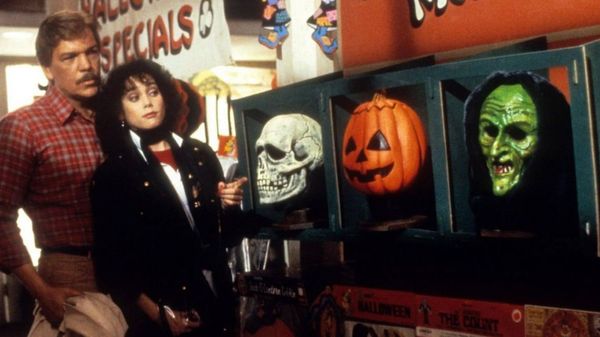
And yet I can put Halloween II on almost any October and have a good time. Donald Pleasence is delightful. Jamie Lee Curtis does more with Laurie than the screenplay gives her. Dick Warlock brings a different but imposing physicality to Michael. The hospital is ridiculous, but it's also an effective horror setting when the movie remembers how to use it. Michael walking through the glass door remains one of my favorite images in the entire franchise, and that final sequence with the blinded Shape swinging his scalpel through the smoke is better than almost anything else in the movie.
Did Halloween need a sequel? No. But once somebody decided there was going to be one, I'm not sure making a direct continuation of that same night was the worst idea.
Halloween II isn't Halloween, but I'm not sure anything was going to be.
And considering where this franchise is eventually going to take us, a watchable, atmospheric, occasionally ridiculous continuation of one of my favorite movies ever made is going to start feeling like a pretty significant accomplishment.
The Fixation Scale
★★★ — 3 out of 4