Franchise Fixation: Halloween III: Season of the Witch (1982)
Halloween III: Season of the Witch took a huge swing by leaving Michael Myers behind. More than four decades later, has this once-maligned sequel gone from underrated to almost overrated?

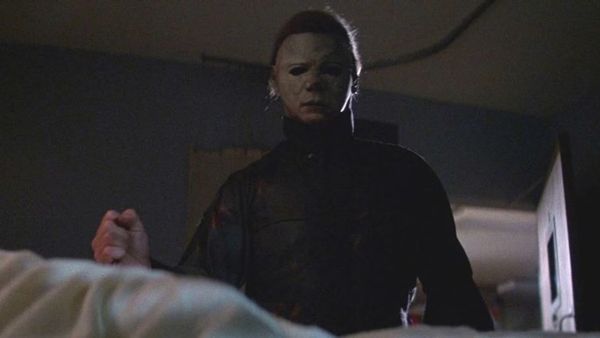
The lack of Michael Myers in Halloween III: Season of the Witch needs to be addressed right away. For me, the absence of Halloween’s titular boogeyman isn't a problem, and I think that is a weak argument for anyone who uses it as a negative. I don’t need Michael Myers to be in every movie with Halloween in the title. Halloween isn’t just the title of a fantastic movie; it’s also a holiday. You could tell different stories based on that holiday, and using this franchise to do that always seemed interesting to me. After two movies about Michael stalking his way through the same town on the same night, letting someone else have a terrible October 31st doesn’t seem unreasonable.
Halloween III certainly gives us someone else having a terrible October 31st; in reality, it’s possibly a large number of someones. If the main villain in this film gets his way, it sounds like it might be the entire country, if not the world, in peril. The movie also gives us killer masks, androids, a stolen piece of Stonehenge, an aggressively catchy advertising jingle, and Tom Atkins making some extremely questionable decisions about how to spend his time.
I appreciate the ambition and how bizarre the movie is willing to get. I’m just not entirely convinced that appreciating those things adds up to loving the movie. This distinction is what makes Halloween III an interesting film to discuss. For years, its reputation was that of a disappointing Halloween sequel without Michael Myers. Now, sometimes it feels like that reputation has completely reversed, and it’s become the brilliant Halloween movie people were too hung up on Michael Myers to appreciate. I’m not on board with the former, but I also can’t 100% get behind the latter, at least not to that degree. I always appreciate a good swing. However, just because you take a big swing doesn’t mean you’re always hitting a home run.
Michael Myers Has the Night Off
Halloween II ends with Michael Myers and Dr. Loomis caught in an enormous hospital explosion. Michael walks out of that explosion completely engulfed in flames before collapsing. As we discussed last time, the ending doesn’t seem particularly interested in leaving either man available for another evening of arguing through gunfire.
John Carpenter and Debra Hill returned as producers for Halloween III, but this time the film would have no narrative connection to what came before. The plan was to turn Halloween into an anthology series, with different stories connected by the holiday. Tommy Lee Wallace, the original movie’s production designer and editor, took over as writer and director. As I already said, the anthology angle is an interesting idea. The problem, or at least one of them, was that Halloween II existed.
I've heard an argument from Halloween fans that Season of the Witch would’ve worked better if it had just been Halloween II. After all, Halloween II brought back Laurie, Loomis, the mask, the music, and even the exact night from the first film. Calling the next movie Halloween III seemed to promise more of that. I understand why people felt misled. Going to a third movie in a series and expecting it to connect to the first two isn’t an unreasonable expectation for moviegoers. Wallace has acknowledged in interviews that audiences weren’t adequately prepared for the change. That’s a marketing problem worth taking seriously.
I do, however, think the Halloween II argument sometimes lets Season of the Witch off too easily. The lackluster marketing very well could have contributed to its box office performance and even its reception by critics and fans. Still, if this had been the second Halloween movie and had the most amazing marketing team behind it, if we’re still getting the same film, that doesn’t make the movie itself any better.
The Man Who Made the Mask Makes the Movie
Wallace’s involvement gives Season of the Witch a connection to Halloween that goes deeper than a producer credit or the number on the poster. He helped turn a Captain Kirk mask into Michael Myers’ face. He also helped shape the original film in the editing room. Whatever else you think about Halloween III, it wasn’t handed to someone unfamiliar with what made the first movie work.
Wallace had declined the opportunity to direct Halloween II, explaining that he wasn’t enthusiastic about the more graphic direction of its screenplay. An entirely different story gave him something he wanted to make. Nigel Kneale wrote the script. Kneale was a British writer best known for works including 1955’s The Quatermass Xperiment. Carpenter hired Kneale, in part, because he loved that movie. In fact, when Carpenter wrote the screenplay for his 1987 film Prince of Darkness, which many people see as a movie in the spirit of the 1955 classic, he used the pen name Martin Quatermass. Carpenter and Wallace then revised it, and Kneale disliked the changes enough to have his name removed. In a later interview, Kneale objected to how much of his original story had been excised, as well as the addition of graphic violence. Wallace has emphasized that much of Kneale’s work remained in the finished film. Regardless, the movie feels like it went through several writers with different ideas about what it should be.
A mix of influences shows up throughout the movie. The first stretch is a mystery. The initial introduction to Santa Mira suggests a conspiracy thriller. The scenes at the mask-making factory take us into science fiction. Conal Cochran (Dan O’Herlihy) eventually brings ancient ritual and supernatural horror into the mix. By the time somebody’s head becomes a delivery system for snakes and insects, we’ve moved into full-blown body horror.
None of those ingredients are inherently incompatible with the others. Ancient evil using modern technology is a perfectly workable horror concept. My problem is how often a new ingredient seems to arrive before the previous one has become convincing. The movie keeps expanding its explanation, and every expansion gives me another thing to wonder about.
Still, Wallace gives it enough atmosphere that I’m willing to follow him into the factory. I just start asking questions once the tour gets going.
Dr. Challis Would Like to Cancel His Parenting Plans
Our new protagonist is Dr. Daniel Challis (Tom Atkins), who encounters Harry Grimbridge (Al Berry) after the terrified man is brought to the hospital clutching a Silver Shamrock Halloween mask. Grimbridge has clearly seen something terrible, and his warning doesn’t become any less ominous when a stranger (Michael Myers’ actor himself from Halloween II, Dick Warlock) arrives and kills him in his hospital bed. The killer then gets into a car and sets himself on fire. So, admittedly, this is a patient’s death that might stay with a doctor longer than the average unpleasant shift.
Harry’s daughter Ellie (Stacey Nelkin) wants to know what happened to her father. Challis agrees to help, and their investigation takes them to Santa Mira, where the Silver Shamrock masks are manufactured. That’s the plot’s reason for the trip. Challis has another reason that becomes much clearer once they check into a motel.
Challis may not be the worst person in the world, but he’s definitely not the most dependable, and he might not always be thinking with the correct “parts.” He has children he’s supposed to be spending time with, an ex-wife who seems to have heard enough excuses, and a general air of being a man whose responsibilities are mostly inconveniences. The movie gives him a medical profession without giving him much of the reassuring stability normally associated with the guy you’d like looking after you in an emergency.
Despite all this, Challis somehow isn’t a bad protagonist. There’s something amusing about a conspiracy this elaborate being discovered by someone who barely seems equipped to manage his own calendar. It’s like an earlier version of The Big Lebowski, if the Dude was a sex-crazed, negligent father who takes more beer with him than clothes on an out-of-town trip. That last part actually sounds exactly like something the Dude would do now that I think about it.
Atkins is a huge part of why the character works as written. He makes Challis feel like a person, not a collection of flaws inserted to make the hero seem complicated. The irritation, curiosity, and growing disbelief are all enjoyable. He can be irresponsible without becoming impossible to follow, and once the danger becomes clear, he brings enough urgency to make me believe this man really does want to stop it.
I also appreciate having a horror protagonist who doesn’t spend the entire movie behaving as if he’s been assembled from a list of admirable qualities. Challis doesn’t need to become an exemplary father before the credits roll. His shortcomings can simply be there. They make him a stranger choice for this story and, for me, a more entertaining one.
I’m not sure, however, the film entirely earns the leap from a doctor concerned about a murdered patient to a man taking off with the patient’s daughter to investigate a mask factory. Ellie has a compelling reason to go. Challis has a murdered patient and plenty of unanswered questions. He also has an attractive traveling companion. The movie seems increasingly focused on that third detail.
Where Do You Want to Sleep, Dr. Challis?
All of this brings us to one of the oddest couplings in this franchise, which is saying something considering how Halloween II introduced Jimmy’s interest in Laurie while she was barely conscious in a hospital bed. Ellie is investigating her father’s death. She has met Challis under circumstances that might encourage some caution. He’s helping her, which is nice, but the movie moves from that arrangement to a sexual relationship with a confidence I don’t entirely share.
“Where do you want to sleep, Dr. Challis?”
Per the movie, that’s all the discussion we need.
I’m not a prude. I just never get much sense of what draws Ellie to Challis beyond the screenplay deciding these two people should sleep together. For him, the attraction is obvious. For her, the character development that might make it feel natural is mostly missing. You could make something interesting out of that. Ellie might be looking for a distraction from grief. Challis might be using the investigation to escape a life he’s neglecting. Two people meeting during a crisis don’t have to make sensible decisions, but the movie doesn’t spend much time exploring those possibilities.
Nelkin has an appealing presence, and Ellie’s determination gives the story its reason to move forward. She’s the one with an actual loss to investigate. I wish the screenplay stayed more interested in that. Once she and Challis are together, she too often becomes the person accompanying him through the movie rather than someone whose grief, suspicions, and choices shape it. That matters even more when we reach the later twist involving her. The movie wants us to react to the possibility that the person Challis has been trying to rescue isn’t who he thinks she is. That would carry more weight if Ellie had been allowed to become a stronger character first.
The relationship is amusing in a strange way, and I understand why it’s part of the film’s appeal for Atkins fans, but it also illustrates one of my larger frustrations with Halloween III. The movie has enough personality to make the coupling memorable, but not enough to make it feel earned. I remember it; I just don’t buy it.
Welcome to Santa Mira, Please Be Indoors by Curfew
Once Challis and Ellie arrive in Santa Mira, Halloween III starts giving me more of what I like about it. The town has an uneasy quality that doesn’t depend on knowing exactly what is happening at the mysterious Silver Shamrock factory. You can feel that something is wrong before the factory tour explains just how wrong. Silver Shamrock isn’t simply a business located in Santa Mira. It dominates the place. The factory supplies the town’s identity and livelihood, and Conal Cochran receives the sort of admiration that makes an outsider’s curiosity unwelcome. The security cameras and curfew aren’t helping the vacation atmosphere either.
In Halloween, Haddonfield feels ordinary until Michael contaminates it. In Halloween III, Santa Mira seems contaminated before our protagonists arrive. They have no comfortable normality to settle into. People can be friendly, but that friendliness comes with rules, and it’s hard to tell who is being helpful and who is making sure the visitors stay where they belong. That’s a good foundation for horror. An entire town can feel threatening without every resident turning toward the camera and announcing they’re in on something. A warning about being out after curfew does more work than a dramatic speech about how suspicious the place is.
The motel also gives the film a useful cast of people with reasons to be near the factory. Marge Guttman (Garn Stephens) is frustrated over a problem with her order. The Kupfer family is visiting because Buddy (Ralph Strait) has successfully sold a lot of Silver Shamrock masks. These people make the company’s reach tangible. This isn’t a mysterious product nobody has ever heard of. Retailers want to sell it, and children want to wear it. Marge’s encounter with the mask’s badge is especially effective as a warning. Before we understand the mechanism, we see that something exceedingly small and apparently harmless can do something appalling. A piece of costume merchandise suddenly becomes dangerous in a way the packaging didn’t mention.
There’s a nice progression here. A terrified man brings a mask to a hospital. Challis and Ellie track the product to a town. The town directs them toward the factory. The factory’s pleasant public face gradually gives way to what’s behind it. This is the part of the movie where the investigation feels as though it’s uncovering something, rather than waiting for Cochran to deliver the information we need.
I could happily spend more time with that version of Halloween III. The company town, the suspicious hospitality, and the sense that nobody will help you get out are creepy enough before anyone even mentions Stonehenge. We’ll get to Stonehenge, I promise.
Cochran Would Like to Show You Something Horrible
Conal Cochran is one of the movie’s strongest elements. He’s a charming host. He’s proud of his company. He seems pleased to have visitors interested in how the masks are made. You could imagine him doing very well in a promotional film about an eccentric entrepreneur who brought prosperity to a struggling town. The promotional film would hopefully omit the child sacrifice.
O’Herlihy, who would dial this villainy up a few more notches in 1987’s RoboCop, doesn’t need to advertise Cochran’s evil in every line. His geniality is what makes him unsettling. He can move from hospitality to a demonstration of mass murder without seeming to experience much change in mood. He isn’t reluctantly committing atrocities for some greater good. He’s enjoying the work. That’s especially apparent in the test involving the Kupfers. These people have every reason to believe they’re being rewarded. Buddy has helped sell the merchandise. Cochran has made them feel special. Being selected to see what happens next sounds like a privilege right up until it becomes the worst thing that could happen to them.
The cruelty works because it’s wrapped in such ordinary business behavior: A factory tour. A successful customer. A special demonstration. Cochran has turned the relationship between a manufacturer and the people who support his product into a way to deliver victims directly to him. His explanation of the plan gives him a different sort of menace. Cochran connects Halloween to an older tradition of sacrifice and treats the modern holiday as a convenient opportunity to do something enormous. The children’s celebrations have become the distribution system for his ritual. That’s a pretty horrible thought, and O’Herlihy delivers it with enough conviction that I’m willing to listen even when the mechanics start getting ridiculous.
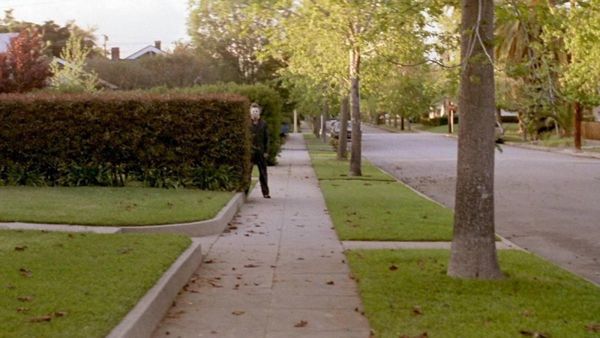
I also like how little this resembles Michael Myers. Cochran talks. He explains. He manages people. He needs a supply chain. His evil has administrative requirements. That’s funny to think about, but it’s also a useful demonstration of what an anthology approach could offer. The franchise could give us a villain whose entire method of operating has nothing to do with standing silently behind a hedge.
Cochran is a good enough villain to make that change worthwhile. If the movie around him were more consistent, I think he’d give this experiment a much stronger foundation. As it is, O’Herlihy sometimes sells the plan better than the screenplay does.
Stonehenge Has Entered the Conversation
Here’s where Halloween III becomes very Halloween III.
Cochran has stolen a stone from Stonehenge, transported it to his factory, and used pieces of it in microchips attached to the Silver Shamrock masks. A television broadcast will activate those chips; children wearing the masks will die, and their parents have quite a bit to worry about too. Also, his workers include androids, because of course they do.
Horror often shows us the impossible. The question for me is whether the movie makes its impossibility convincing enough to keep me engaged. Sometimes Season of the Witch does. For instance, Cochran’s demonstration of what the Silver Shamrock masks can actually do makes the supernatural threat horribly concrete. The more the movie tries to explain the machinery behind that threat, however, the less effective it becomes for me. Every new detail gives me another opportunity to wonder why Cochran needs this particular arrangement or how it functions in relation to the ritual.
The Stonehenge material is amusing partly because it’s presented with so little interest in the practical difficulty of what he’s done. Cochran has somehow arranged to steal and transport an enormous ancient stone, which sounds like a logistical achievement that could have been an entire movie on its own. Instead, it’s one stop on the tour. Here’s the manufacturing equipment, here are the androids, and over here is the missing piece of Stonehenge. Please watch your step.
That casual confidence can be fun. I understand the appeal of a movie that simply commits to this much weirdness and expects you to keep up, but confidence and coherence aren’t always the same thing. After a while, the factory starts to feel as though it has access to whatever technology the next scene requires.
The Worst Product Demonstration in America
Little Buddy’s (Brad Schacter) death scene is where those pieces finally produce something I don’t have to think hard about. It’s horrible.
The Kupfers are placed in a room for a special demonstration. The boy wears his pumpkin mask and watches the screen. Then the mask collapses around his head, and snakes and insects emerge. His parents are trapped with him. While Buddy Senior and Betty Kupfer (Jadeen Barbor) are eaten alive by snakes and spiders, Cochran observes the results.
This is dark even for a Halloween movie. The original threatens children, but Tommy and Lindsey survive, and honestly Michael never seems inclined to even go after them. Halloween II includes babies in the hospital without turning the maternity ward into a massacre. Season of the Witch follows a child excited about a mask and a holiday where he’s supposed to get plenty of treats, only for his head to turn into a creepy crawly nightmare. The parents make the scene even more horrifying. They aren’t simply being forced to witness their child’s death; they’re caught in the room as well and face terribly similar ends.
It’s the most convincing argument for the movie’s bizarre premise. Describe the story to someone, and killer Halloween masks powered by Stonehenge can sound like a joke. Show them this sequence, and the idea suddenly feels genuinely frightening. It also exposes an interesting difference between Halloween II’s violence and the violence here. In my Halloween II review, I noted that much of the added gore felt less frightening than the original’s suspense. This sequence is certainly graphic, but the horror isn’t limited to what the effects show us. It’s built into the situation. We know these people have been invited into a trap, and the very product they believe they're being rewarded for selling is what kills them.
Still, as effective as this scene is on its own, its impact on the film's overall structure is something else entirely. Why exactly is Cochran doing this specifically to the Kupfers? They don’t know his secrets; if anything, Buddy is helping him by being the top mask seller, giving Cochran more ammunition to use to take over the world, or whatever his end goal might be. I guess one could argue this is a test he’s running to make sure it all works, but if that’s true, why wait until the day before Halloween to run it? Maybe I’m overthinking the logistics of a movie involving killer masks powered by a stolen piece of Stonehenge. Still, these questions start to matter when they repeatedly pull me out of scenes that otherwise work. Halloween III has several terrific ideas and individual sequences. Too often, the connective tissue between them exists mainly because the movie needs to get from one memorable moment to the next.
What this sequence does beautifully, though, is give viewers enough context to make the morbid payoff at the end of the film work. One family unit in front of a TV set, a very common visual for the 1980s, establishes what Cochran has prepared for everybody else. By the end, a television still playing an advertisement is enough to make us imagine something much worse than the picture on the screen.
The Commercial You Will Never Get Out of Your Head
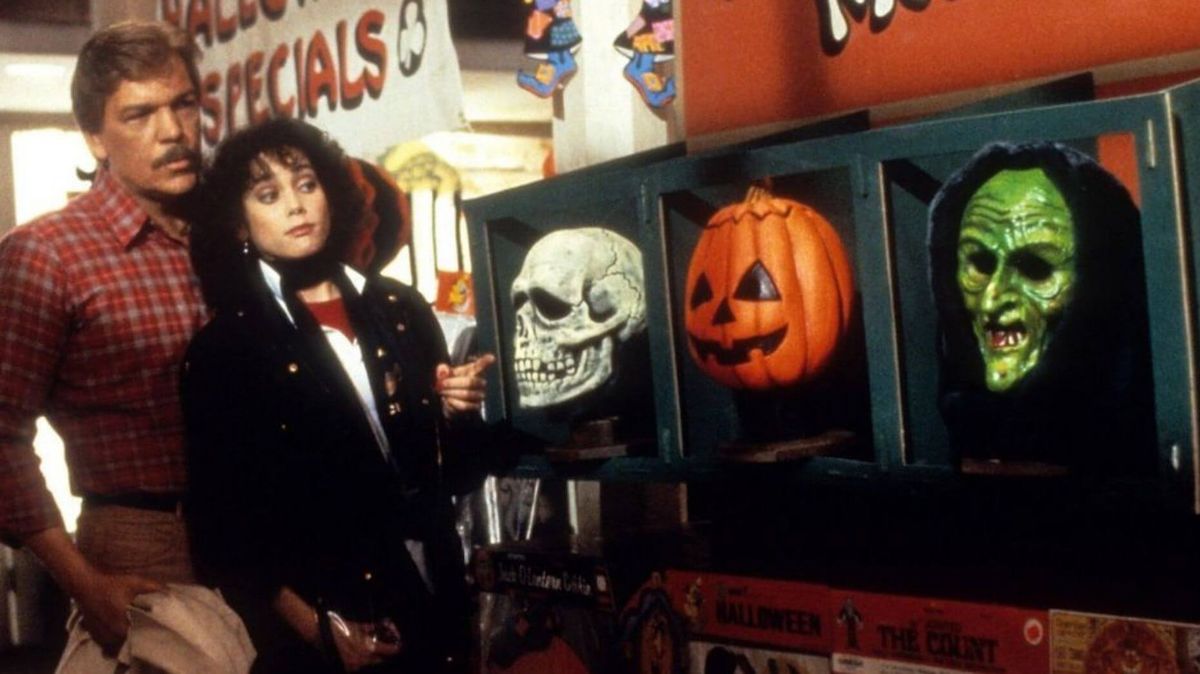
Whatever problems I have with this movie, I cannot accuse its in-movie advertising department of failing to make an impression. Silver Shamrock has three masks and approximately one tune, and by the end it feels as though we’ve all been subjected to the entire campaign.
The jingle uses the melody of London Bridge, with an increasingly insistent countdown to Halloween. Wallace has explained that the production needed music it could afford, so it used a familiar public-domain tune, with his own sped-up voice contributing to the commercial. That practical production choice becomes one of the film’s defining features. I’m not going to reproduce the lyrics here. You’re welcome.
Its repetition does have a purpose beyond making sure you’re still hearing it when you go to bed. The advertisement keeps bringing the characters and the audience back to the approaching deadline. The movie can spend time investigating Santa Mira, but the campaign is still running. Children elsewhere are still watching. The masks are still being sold. This gives the commercial an increasingly unpleasant meaning. Early on, it’s just annoying. Once we understand the plan, every repetition becomes evidence that Cochran’s preparations are continuing exactly as intended. Something Challis hears in passing is something families across the country are using to organize their Halloween evening and potential deaths.
Halloween III also has a nasty observation about marketing built into the plot. Cochran doesn’t have to force children to put on the masks. Despite the simplicity of the designs (a witch, skull, and jack-o-lantern), Cochran makes them desirable. He doesn’t have to drag families into a room with a television because he packages the masks along with Halloween night as a can’t-miss event. Parents buy the merchandise and help their children get ready for the broadcast because, as far as they know, they’re doing something harmless and fun.
You can see why this part of the film has endured. The commercial is easy to remember, the masks are recognizable, and the connection between those two things is central to the horror. The movie’s villain has built a successful brand, and the brand does much of the work for him, giving us a stronger idea than some of the factory mechanics used to carry it out. The broadcast gives the story a threat that extends well beyond wherever Challis happens to be standing. He can escape a room or destroy a machine and still fail, because the company has already put its product into homes. It’s hard to stop a conspiracy once people are enthusiastically following its instructions. That message will probably, and sadly, always be relatable.
It Still Looks and Sounds Like a Halloween Movie
Another reason I’m willing to stick with Season of the Witch, despite its stranger developments, is that it connects to the first two films in how it looks and sounds. The characters have changed, but the filmmaking hasn’t become completely unfamiliar.
Dean Cundey returns as cinematographer, and once again that matters. The frame has a sense of space that lets the environment feel threatening. Challis and Ellie can occupy part of the image while the town or factory feels as if it’s watching them from somewhere else. I especially like how the film shifts from the open countryside around Santa Mira to the more controlled spaces inside it.
John Carpenter and Alan Howarth provide the score, and the electronic music fits this story well. It doesn’t need to recreate the original Halloween theme to suggest that something terrible is approaching. The music's pulse suits the machinery and countdown, while the darker sustained passages make the investigation feel more ominous than the dialogue alone sometimes manages. The opening credits introduce that shift well. We still get a pumpkin, but it takes shape electronically. After the first film’s jack-o’-lantern and Halloween II’s pumpkin revealing a skull, this one looks as if Halloween has entered a computer. That’s a fitting image for a movie where an ancient ritual is being delivered through modern electronics. Unfortunately, good photography and a strong score also make the shortcomings more noticeable. I can enjoy a scene's mood while realizing it hasn’t given Ellie much to do or moved the mystery much forward. The movie often has the right atmosphere for a better version of itself.
Ellie Has Become a Different Sort of Problem
Eventually Challis discovers enough of Cochran’s operation to fight back. He escapes the situation designed to kill him, turns the factory’s own system against it, and gets Ellie out. For a while, Halloween III seems to give him a reasonably conventional victory. Then Ellie attacks him, and we discover that the woman he has rescued is an android.
This is the sort of twist that makes an immediate impression and becomes more frustrating the longer I think about it. At some point, Ellie was replaced. The film doesn’t clearly establish when that happened or what became of the real woman. The uncertainty could be disturbing, but in practice, I spend more time trying to understand what the replacement has been doing. Why allow Challis to get as far as he does? Why wait until after the escape to attack? The android has been in a position to cause him considerable trouble before this. There may be explanations involving its instructions or Cochran’s priorities, but I don’t think the movie gives us enough to make those explanations feel like part of the story rather than something we’re supplying afterward. So, because Ellie hasn’t developed much beyond being Challis’ companion, the reveal feels more like another attack than the destruction of a relationship I’ve become invested in. Nelkin’s character disappears into a mechanical surprise. Challis has to fight it. On we go.
I don’t object to the androids simply because they’re androids. The suited men’s blank efficiency can be creepy, and having human-looking workers who follow Cochran’s orders without resistance fits the company’s control over Santa Mira. But Ellie’s replacement is where that device seems to complicate the story more than it enriches it. The repeated effort required to stop her does at least give Challis one last miserable obstacle. By this point, the man who went away with Ellie has ended up fighting parts of a machine that looks like her. It’s an appropriately grotesque outcome for this particular road trip.
I just wish the surprise made more sense within the conspiracy. Halloween III has asked me to accept a lot, and here it asks for another leap at the exact moment I’d rather be concentrating on the television broadcast we know is coming. Thankfully, that’s where it goes next.
Somebody, Please Turn Off the Television
The ending is terrific. I don’t really have a qualification to attach to that.
Challis reaches a telephone and tries to have the Silver Shamrock commercial taken off the air. Two stations stop it. The third continues broadcasting. Children watch, and Challis grows increasingly desperate as he tries to get someone to listen. The film ends with him screaming for the broadcast to stop.
We don’t see what happens in the homes watching that third channel. We don’t have to. The demonstration with the Kupfers has already supplied the information, and the commercial has spent the movie making itself recognizable. Now those two things come together. A familiar piece of advertising becomes a catastrophe that may already be happening. Atkins is excellent here. The irritation and casual irresponsibility that made Challis entertaining earlier have given way to panic. Whatever his reasons for joining Ellie, he now understands what is about to happen and has almost no power to prevent it. Being correct doesn’t matter if he can’t convince someone on the other end of the line quickly enough.
The scale finally becomes frightening. Michael Myers can be terrifying because he’s in the house with you. Cochran’s scheme is terrifying here because Challis can’t get to all the houses. The danger has already been distributed, sold, and advertised. Stopping the man who arranged it may not be enough. Wallace has said that the studio wanted a softer ending, while Carpenter supported his decision to leave it unresolved. Wallace compared his approach to the bleak conclusion originally intended for the 1956 Invasion of the Body Snatchers, before additional scenes were added to give audiences a little more hope. Interestingly, the 1978 remake of Body Snatchers had no such reservations, ending on an even bleaker note. Halloween III follows a similar philosophy: leave the audience with the horror rather than reassure them that everything is going to be okay.
The movie’s refusal to tell us whether Dr. Challis succeeds is exactly right. Showing every mask activate would make the disaster explicit. Confirming that the final station stops would turn the story into a much more comfortable escape. Leaving us with his desperation allows both possibilities to remain, with the one we dread feeling much too close. It’s also one of the places where Halloween III earns a real connection to the original. Halloween ends with a threat that has survived everything the protagonists did to stop it. Season of the Witch ends with the possibility that its threat has survived the destruction of the operation behind it.
Different villains; unbelievably bad news either way.
From Underrated to Almost Overrated
Halloween III has developed quite a following in the forty-four years since its release, and I understand why. If you spend years hearing that a movie is worthless because it doesn’t contain Michael Myers, discovering Cochran, the masks, the commercial, and that ending can feel like finding something that was hidden in plain sight.
It deserves to be judged as the movie it actually is. The anthology experiment was interesting. O’Herlihy is exceptionally good. Atkins, along with the writers, gives us an entertainingly flawed protagonist. The photography and music provide atmosphere the film can genuinely use, and the test sequence and final phone call are strong enough to stay with you long after the plot details have started raising questions.
But I think its reassessment sometimes gives the movie credit simply for being different. Being the strangest installment in a franchise doesn’t automatically make it one of the best. Taking a risk can produce a fascinating failure, an uneven success, or a great film; it’s up to you to decide where Halloween III: Season of the Witch falls.
For me, Season of the Witch is uneven, with a handful of excellent elements. Challis is fun, but his relationship with Ellie is awkward. Ellie has a compelling reason to begin the story, but she doesn’t become compelling enough as a character. Santa Mira is creepy, but the investigation doesn’t always sustain that feeling. The premise is imaginative, but the factory’s expanding collection of explanations makes it harder for me to stay involved. Then little Buddy puts on the mask, or Challis starts screaming into the telephone, and for a few minutes the movie becomes as frightening and fun as its defenders say.
I wish it stayed there longer.
That’s why I can appreciate the film’s following without entirely joining it. I’m glad people found something to love here. I don’t think the old dismissal was fair, but I also don’t think affection for an abandoned idea should require me to overlook the film’s problems. Halloween III has gone from underrated to almost overrated for me, which is a hell of a feat. I can enjoy its peculiarities and still wish they added up to a stronger whole.
THE FIXATION SCALE
★★½ — 2½ out of 4