Franchise Fixation: Halloween (2007)
Rob Zombie brings Michael Myers back to Haddonfield. I wish I had enjoyed the trip more.

When Rob Zombie was announced as the man who would bring Halloween back to theaters, I was genuinely excited. That might sound strange considering I wasn’t a particularly big fan of his first two movies. House of 1000 Corpses hadn’t done much for me, and I thought only half of The Devil’s Rejects worked. Still, he clearly loved horror, and there was something appealing about handing a franchise that had just given us Halloween: Resurrection to somebody with a recognizable personality and a willingness to take chances.
I wasn’t necessarily asking for a remake. I wasn’t even sure I wanted one. But after Resurrection, I also couldn’t tell you where the series was supposed to go next. Zombie seemed like someone who might have an answer. I wanted to see him become a great horror filmmaker, and I thought Halloween might be the opportunity.
Then I saw the movie.
I didn’t hate it in 2007, and I don’t hate it now. I like some performances, admire some ideas, and find entire stretches more interesting than I remember. Somehow, though, this remains one of the hardest Halloween movies for me to sit through. Not the worst; not even close to the most inept; just exhausting in a way that even some of the franchise’s considerably worse entries aren’t.
(One clarification before we go any further: I’m discussing the theatrical version, as I’ve done with the previous installments in this series. Zombie’s director’s cut is widely available and makes some consequential changes, so we’ll get to those as well. For now, we’re starting with the movie audiences saw in theaters in 2007.)
What Do You Do After Resurrection?
By the time Zombie arrived, the series had already tried a little of everything. It had killed off Laurie Strode, resurrected her, killed her again, introduced a cult, discarded that cult, and sent Michael Myers into a house full of internet reality-show contestants. The franchise was in a peculiar position. Michael remained a valuable horror icon, but after Halloween: Resurrection, it was becoming increasingly difficult to figure out what to do with him next.
That didn't stop people from trying.
Several ideas for a ninth Halloween film were considered before they decided to start over. One proposed direct sequel to Resurrection would've opened by killing off Freddie Harris, Busta Rhymes' character from the previous film. Considering Freddie had survived an encounter with Michael Myers by electrocuting him in the crotch and delivering a flying martial-arts kick, I can't imagine too many fans would've been devastated by that development. More interestingly, the proposed story would've brought back John Tate, Laurie's son from Halloween H20, played by Josh Hartnett, and paired him with Sheriff Leigh Brackett, the character Charles Cyphers had played in the first two films. Bringing those characters together to hunt Michael is certainly intriguing, though it raises the question of how much more mileage the filmmakers could've gotten out of the Laurie Strode family saga. Then again, considering what this franchise would eventually do with Laurie and Michael, perhaps we hadn't even scratched the surface.
Another possibility would've been to return to the Cult of Thorn mythology introduced in Halloween: The Curse of Michael Myers. Considering the franchise had already spent considerable effort abandoning that storyline, resurrecting it would've been an interesting choice.
A proposed prequel, Halloween: The Missing Years, would've explored Michael's childhood and his time at Smith's Grove Sanitarium. Rather than continuing to invent new reasons for Michael to return to Haddonfield, this approach would've gone backward and attempted to fill in the years between Judith Myers' murder and his escape in 1978. Of all these possibilities, that last one is particularly interesting in hindsight, because it's essentially part of what Rob Zombie would eventually bring to the franchise.
I don't necessarily think any of these abandoned projects would've produced a great Halloween movie. We've spent eight films watching this series attempt to reinvent itself, sometimes successfully and sometimes spectacularly unsuccessfully. Bringing back John Tate might've been fun. Revisiting Thorn might've satisfied fans who felt that storyline deserved a better conclusion. Exploring Michael's childhood offered something the franchise hadn't really attempted before, aside from a few extra sequences shot for the 1981 TV edit of the original Halloween. Each idea had possibilities, but each also came with its own problems.
Ultimately, the decision was made to stop worrying about which continuity to follow and start the entire story over.
Enter Rob Zombie.
What makes Zombie's involvement interesting is that he didn't simply want to make another Halloween movie with a different group of teenagers waiting around for Michael Myers to kill them. He wanted to explore the character from the beginning, spending considerable time with Michael as a child, his dysfunctional family, and the psychiatrist attempting to understand what was happening inside his head. In other words, Zombie was taking an idea the franchise had considered before and using it as the foundation for an entirely new interpretation of Halloween.
There's something genuinely appealing about that approach. After eight films, I certainly wasn't interested in watching another filmmaker attempt to recreate John Carpenter's suspense techniques with diminishing returns. If the franchise was going to start over, why not allow someone with a completely different sensibility to do something different?
Unfortunately, Zombie's ambitions don't always translate into a cohesive film. His interest in Michael's childhood and institutionalization gives us material the franchise had largely avoided, but he also has an entire Halloween story to tell once Michael returns to Haddonfield. Balancing those two approaches is one of the movie's biggest problems, and we'll get into it shortly.
The Trouble With Explaining Michael Myers
The original Halloween understood the power of withholding an explanation. Michael wasn’t frightening because we knew his childhood, his grievances, or his psychology. He was frightening because we didn’t. I’ve spent a lot of this series complaining about the various explanations later filmmakers tried to attach to him, so you might expect me to reject Zombie’s origin story immediately.
Surprisingly, I don’t. At least not entirely. The first half is stronger, and the time at Smith’s Grove offers some of its most effective material. We have to deal with the sister connection right off the bat. We even see Laurie as a baby, whom Michael (Daeg Faerch) affectionately calls Boo. However, Zombie isn’t obligated to preserve Carpenter’s conception of Michael. If we’re going to remake Halloween, I’d rather somebody take a different route than produce an imitation with less accomplished suspense.
The problem is that Zombie doesn’t really show us how an ordinary child becomes a murderer. Michael is already killing animals before the main events begin. We learn about a dead cat, photographs of mutilated animals, and our actual introduction to Michael is him preparing to slaughter his pet mouse. By the time the movie starts giving us reasons to examine his home life, the most important transformation has apparently already happened.
The Myers household is relentlessly miserable. Nearly every conversation becomes an insult, a threat, or a shouting match. I understand the intended environment. I also understand that awful people and awful homes exist. What I don’t understand is why so many of these characters have to sound like they’re competing to deliver the most aggressively unpleasant line in the screenplay. It’s difficult to invest in people who barely seem to exist beyond their capacity to abuse one another.
William Forsythe certainly commits to the stepfather (or shitty boyfriend to Michael’s mother; the movie never really clarifies, or I didn’t care enough to listen), and young Michael’s encounters with his school bully (Daryl Sabara) and his sister, Judith (Hannah Hall), and her boyfriend (Stan Payne) add to the portrait of a cruel world. Yet the supporting characters are so thinly drawn that the cruelty starts to feel less revealing than repetitive. Eventually, the movie stops showing us something new about Michael’s environment; it just shows us more of the same.
A Mother, a Son, and a Psychiatrist
There is, however, a much more interesting movie trying to get out of this material, and a lot of it belongs to Sheri Moon Zombie. I think she’s very good as Deborah Myers, perhaps better here than in anything else I’ve seen her do. She has to love her son while slowly confronting the fact that he has murdered another of her children. That’s a genuinely terrible emotional position, and she gives it a humanity much of the surrounding film lacks.
Daeg Faerch is more uneven for me as young Michael. I’m not always convinced by the transition into the Halloween-night murders, but I like several of his scenes after he’s institutionalized. His confusion, denial, and insistence that he should be allowed to go home give the story a dimension that the household shouting never manages.
The best moments often come when Malcolm McDowell’s Dr. Loomis is sitting across from Michael, trying to reach him. When Michael asks why he can’t go home, and Loomis tells him he's done terrible things, the exchange is simple and devastating. For a moment, the movie trusts its actors and its situation rather than trying to overwhelm us. I wish there were more moments like it.
Zombie also makes Michael obsessed with making masks. I find the symbolism a little clumsy, as though we need another visible indicator that the boy is withdrawing from the world: Rob Zombie, thy name is not subtlety. Still, the idea has some value. The masks become a barrier between Michael and everyone trying to reach him, and at least it’s an idea developed specifically for this interpretation.
Two Movies Fighting for the Same Running Time
Michael (now played by Tyler Mane) eventually grows up, escapes, and returns to Haddonfield. Suddenly, the movie that has spent so much time developing its own history begins racing through the familiar events of Carpenter’s film. This is where the movie loses me. Not because it’s different from the original, but because it stops being different in any particularly interesting way. After spending so long on the origin story, Zombie crams much of the original film’s narrative into a relatively short stretch. Then, almost as quickly, he abandons the remake structure again for an extended confrontation between Michael and Laurie.
This endeavor could be a compelling movie about young Michael and Loomis. It also offers a potentially compelling story about a new Laurie Strode facing an enormous, brutally physical Michael Myers. Trying to fit both into one film leaves the first story without a satisfying conclusion and the second without enough room to breathe.
That imbalance makes comparison with Carpenter’s original film unavoidable, even though I’m trying not to make that the standard. In this version, Michael is less a trickster and mysterious monster hiding in the shadows, and more a weapon of mass destruction, violently tearing through anyone in his way. I don’t mind this in theory; Zombie has every right to substitute violence for patient suspense. The issue is that his movie spends just enough time recreating familiar situations to remind us of what those situations once accomplished, without finding an equally persuasive rhythm of its own.
Michael Myers, Now With Considerably More Michael Myers
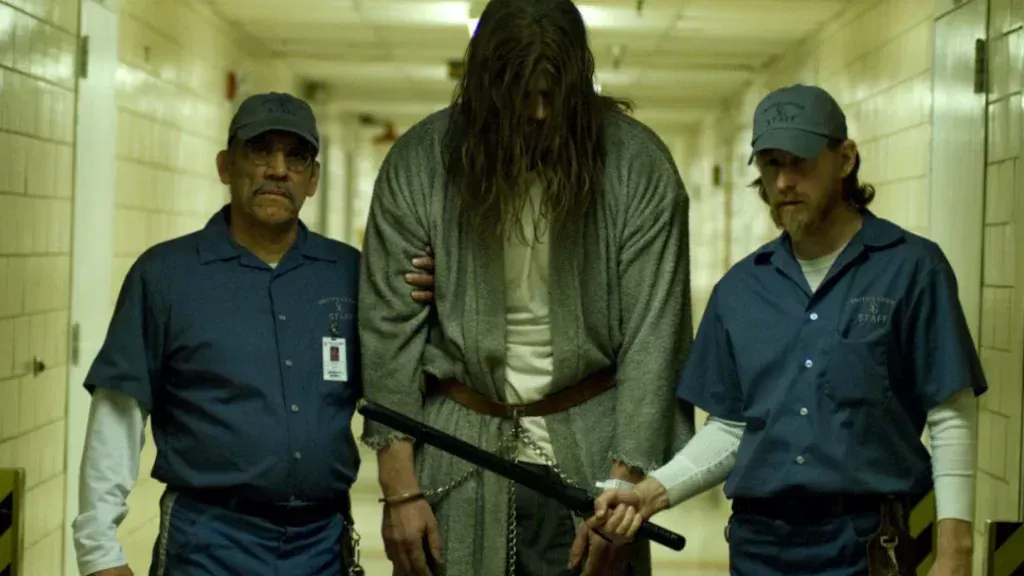
Tyler Mane is an imposing presence. That might be an understatement. Like I’ve already foreshadowed, this Michael feels enormous, a walking threat who can overpower almost anybody unfortunate enough to cross his path. Zombie stages violence as something ugly and exhausting, and I don’t object to that approach on principle. Horror doesn’t have to be delicate. A lot of the best horror isn’t.
What bothers me is how Michael seems to materialize wherever the script needs him. He can finish one attack and turn up across town spying on another victim, with the movie giving us little sense of how he got there. Previous incarnations of Michael, including Carpenter's version, also moved in ways that invited questions, but the original film at least built a geography of streets, houses, windows, and sight lines that made his presence unsettling. Zombie’s Michael often feels less like someone stalking Haddonfield and more like someone being instantly delivered to his next scene.
It’s especially noticeable because Mane is so physically distinctive. I’m not entirely sure how a man of that size is supposed to disappear into so many suburban hiding places. The movie’s sheer force works better when Michael directly confronts someone than when it asks him to function as a barely glimpsed figure in the background. I wish Zombie had gone 100% in that direction, rather than trying to keep some of the Carpenter flair along the way. Who knows how much of this was studio interference, though. Zombie has implied, and in some cases outright said, that the Weinstein's weren’t exactly subtle with their opinions during filming of both this and the 2009 sequel.
A Different Laurie and a Different Loomis
Scout Taylor-Compton isn’t the problem with Laurie Strode. I have no objection to reinventing Laurie as a louder, more openly rebellious teenager. The difficulty is that the screenplay rarely gives me much reason to care about her before the danger starts. I certainly don’t want her to die, but that’s not quite the same as being invested in her survival.
Danielle Harris, meanwhile, is a welcome presence as Annie. After playing Jamie Lloyd in Halloween 4 and Halloween 5, she returns to the franchise in a completely different role and gives the film some of its more sympathetic moments. Brad Dourif (one of our most underappreciated actors) also works well as Sheriff Brackett. The interactions between Dourif and McDowell are among my favorite scenes, and there are way too few, partly because both actors can suggest a relationship beyond whatever the immediate plot requires.
McDowell is an inspired choice for Loomis, at least on paper, and I like him very much in the first half. His Loomis can be personable and engaged with Michael, rather than starting as a man who's already decided he's looking at pure evil. The scene where, after 15 years of Michael refusing to speak during their sessions, Loomis finally tells him he's done trying to get through to him is surprisingly powerful, even if it feels a little rushed. Unfortunately, the later material largely undoes the complexity established in the first half. By Halloween night, 1978, Loomis has adopted the familiar urgency and starts resembling an exaggerated version of the character we already know, trench coat and all. The problem isn't necessarily that he's determined to stop Michael; it’s that the movie never convincingly bridges the gap between the psychiatrist who finally gave up on his patient and the man who suddenly defies authority to join the hunt.
Rounding out Zombie’s ensemble is a slew of familiar faces: Dee Wallace, Richard Lynch, Danny Trejo, Leslie Easterbrook, Bill Moseley, Clint Howard, and others. Whatever problems I have with RZ's movies, the man knows how to assemble a cast that makes a horror fan smile. Sometimes the pleasure of recognizing an actor lasts longer than the character’s actual contribution, but I’m not going to complain about seeing these people on screen.
Haddonfield, With Extra Pumpkins
The movie looks terrific in places. Zombie clearly loves Halloween iconography, and he covers Haddonfield in so many jack-o’-lanterns that he could stock several pumpkin farms. I appreciate the commitment. Some shots, with their atmosphere, seasonal decorations, and location textures, almost convince me I’m about to fall in love with the movie.
Then somebody starts talking.
Zombie’s dialogue has always been a sticking point for me. In the Firefly movies, that heightened, abrasive way of speaking at least fits a world built around equally abrasive people. Transplant it into suburban Illinois, and I find it harder to accept. People curse and shout everywhere, obviously. The problem isn’t profanity; it’s that so many characters sound as though they share the same writerly impulse to turn every interaction into a confrontation.
Combined with the violence, the constant abrasive dialogue gives Halloween an unpleasantness I suspect is entirely intentional. The trouble is that intentional unpleasantness still has to do something for me. Too often I feel worn down rather than frightened, unsettled rather than engaged. Those are different reactions, and for this particular movie the distinction matters.
The Theatrical Cut and the Director’s Cut
I’d like to get back to why I specified earlier which version I watched. The director’s cut changes the escape from Smith’s Grove in a way that has always bothered me: it introduces a sexual assault involving two orderlies and a female patient in Michael’s cell, which leads into the violence surrounding his escape. The theatrical cut avoids that sequence. For me, its absence is an improvement, and not a minor one.
One bit I wish had remained in the theatrical cut, however, is the director’s cut version of Michael attacking Loomis. In the theatrical version, Michael seemingly gouges out Loomis’s eyes, making his return in the sequel with little to no visible injuries rather confusing. In the director’s cut, Loomis is instead tackled through a wall, his eyes presumably still intact, and we see him looking up at Laurie and breathing as she's rescued. At least that version leaves considerably less doubt about how he could've survived the encounter.
I know some viewers prefer the director’s cut, and I’m not dismissing that preference. Despite the issue with Loomis's fate, I think the theatrical version is the stronger experience. When writing these retrospectives, I also think it makes the most sense to focus on the versions audiences originally saw in theaters. Besides, I’m not kidding about how much the movie improves by removing that sexual assault sequence.
The Movie I Wanted to Love
What makes this movie the most frustrating is that I can see a version of it I might have loved. Keep more of Deborah Myers. Give the young Michael and Loomis material room to develop. Let the adult Michael’s story grow out of that material rather than racing through familiar beats before swerving into something else. Most of all, give me people whose lives feel worth interrupting before Michael comes through the door.
I can appreciate the performances, the autumn atmosphere, and Zombie’s refusal to politely imitate Carpenter. I can also understand why the movie has such devoted defenders. Its brutality, its vision of Michael, and its refusal to soften the ugliness are precisely the qualities some viewers respond to. I’m not going to tell them they’re wrong for finding something here that I don’t.
But I keep returning to the same strange conclusion. While I think Halloween: The Curse of Michael Myers and Halloween: Resurrection are worse movies, I would still have an easier time sitting through either of them tonight. Zombie’s Halloween has more ambition than those films, and is probably more worth discussing. It just feels like it’s fighting me almost every minute I spend with it. At the end of the day, based on my opinions of his other films, Rob Zombie might just not be a director I can connect with, and that’s okay.
I wanted Rob Zombie to save Halloween, and maybe in hindsight that was expecting too much. Instead, he made a Halloween movie I respect (at times) more than I enjoy. Sometimes that’s where the conversation has to end.
THE FIXATION SCALE
★★☆☆
2 out of 4