Franchise Fixation: Halloween (2018)
Forty years after the original, Laurie Strode returns to confront Michael Myers again. Halloween (2018) has some genuinely effective scares and welcome performances, but I find it much easier to appreciate in pieces than as a whole.

I went into Halloween (2018) not entirely sure what to expect. Jamie Lee Curtis returning as Laurie Strode was obviously welcome news. The decision to make the movie a direct sequel to John Carpenter’s original, ignoring every installment in between, inspired considerably less enthusiasm. I never particularly loved the revelation that Laurie was Michael’s sister, but forty years later, that relationship had become so ingrained in the franchise’s mythology that I couldn’t imagine watching a new Halloween movie without thinking about it. I realize that’s a “me” thing, but surely I couldn’t have been the only person coming into this movie with nearly four decades of franchise baggage.
By this point, though, Halloween had already rewritten its own history so many times that I could hardly blame anyone for trying again. What interested me more was the collection of people trying it: David Gordon Green and Danny McBride, filmmakers I associated more with comedy and drama than masked killers, working with Blumhouse and the returning John Carpenter. That was an intriguing combination, even if I wasn’t convinced it would produce a great Halloween movie.
The result is not a bad movie. Some moments here deserve to stand alongside some of the franchise’s better sequences; the “closet scene” is a particular highlight. This is also the first time since Jamie and Rachel that I can remember enjoying so many of the franchise's new characters. The film makes some inspired choices throughout its runtime; there’s no doubt. However, every time I start warming to the movie, it seems determined to remind me of another choice I don’t particularly like. Halloween (2018) can be entertaining, but I find it easier to appreciate in pieces than as a whole.
The Third Movie Called Halloween
First, we need to discuss the title. This is the third movie in the franchise titled "Halloween". The first was the original, and the second, of course, was Rob Zombie’s remake, which is the only time in a franchise when the retitling makes sense (I’m also looking at you, Scream (2022)). This one is an actual sequel, and apparently the best way to distinguish it from the other two is to make everyone append a year in parentheses forever. Thanks, everybody.
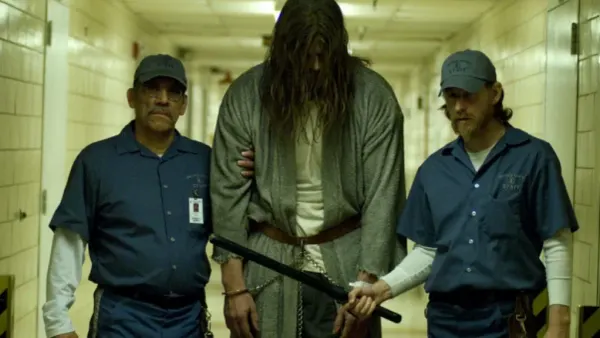
The new continuity removes the sibling relationship introduced in Halloween II (1981). Michael Myers and Laurie Strode are no longer brother and sister. Michael was captured after the events of the original movie and has spent the intervening decades institutionalized. Laurie, meanwhile, has spent those same decades preparing for the possibility that he might come back. Once again, we have a Halloween movie in which Michael is being transferred between facilities at precisely the wrong time of year. You would think somebody in Illinois would eventually look at a calendar.
I understand the appeal of going back to the original film’s conception of Michael as an inexplicable force of evil. I’ve spent plenty of time arguing that Michael works best when the movies stop explaining him. The problem is that this particular sequel still wants Laurie and Michael’s confrontation to be the center of everything. Remove the family connection, and you need to find a convincing reason for their paths to cross again. As we’ll see, the screenplay has a solution, but I’m not especially fond of it.
The abandoned opening is even stranger. One early script replayed the conclusion of the 1978 film, only to have Michael kill Dr. Loomis before Laurie shot Michael herself. According to producer Ryan Turek, Carpenter objected to rewriting his ending. Green separately considered a new perspective on Michael's capture after the balcony fall; they rebuilt a bedroom set, but dropped the sequence as time and money ran short. Imagine announcing you're returning to the original Halloween, then opening by retroactively killing Dr. Sam Loomis. That's one way to start a conversation with fans, I suppose.
Getting to that clean slate apparently took a lot of dirty work. Green has described something like eighty drafts over eight months, with early attempts to accommodate the sequels before the filmmakers settled on treating Carpenter's film as the only history that counted. He also discussed versions that shifted the story's center toward Karen when Jamie Lee Curtis's participation wasn't certain. Once Curtis came aboard, Laurie became a much larger part of the film. I can see why they made that choice. I can also see why trying to satisfy forty years of expectations while insisting that thirty-nine of those years never happened might get complicated.
Halloween: H40?
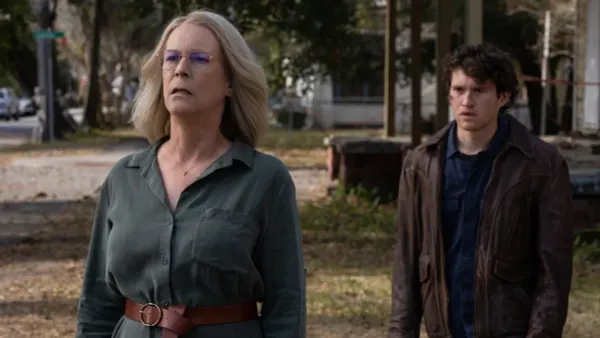
For all the talk about wiping the slate clean, the movie I kept thinking about was Halloween H20: 20 Years Later. Both films bring back Jamie Lee Curtis as a Laurie Strode whose life has been shaped by what happened in 1978. Both give her a younger generation to worry about. Both films explore the lasting psychological damage Michael Myers inflicted on Laurie Strode, but they take very different approaches to how she deals with that trauma. This film has greater ambitions in some respects, but I’m not convinced it does a better job of showing us the woman underneath all that trauma.
In H20, Laurie is struggling with alcohol, anxiety, and the exhausting work of trying to pass as someone who has moved on. Here, she has fortified a remote house and assembled what appears to be every firearm in the state of Illinois. She is less a recognizable person and more a Charles Bronson character waiting for a Death Wish sequel to begin. She's not simply afraid Michael might escape. She actually wants him to. Laurie admits to Officer Hawkins that she's prayed for Michael to escape so she can kill him herself, prompting Hawkins to respond, "Well, that was a dumb thing to pray for." It's a pretty great exchange, partly because Hawkins reacts to Laurie's declaration with about the same level of disbelief I imagine most reasonable people would. It also effectively illustrates how thoroughly Michael Myers has consumed her life.
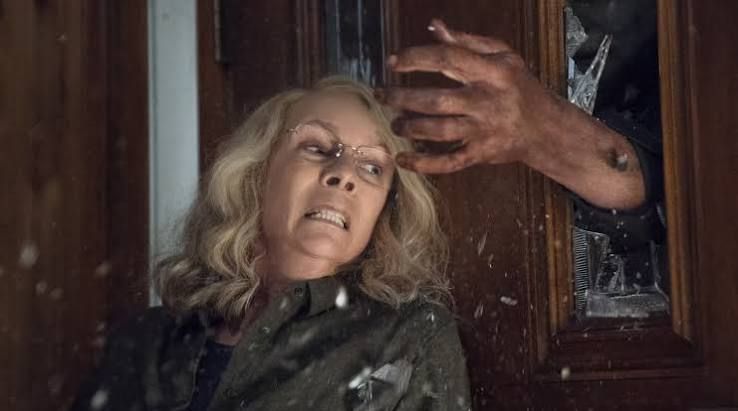
Still, despite the moments this new version of Laurie and the new Halloween timeline shine, too many moments pale in comparison to earlier entries. Compare the moment Michael and Laurie see one another through the door in H20 with their encounter here, when Michael smashes his hand through a door window and grabs her. The latter is certainly more violent. The former, for me, says more with a glance. Maybe comparing the two films is unfair, but when a sequel follows so much of H20’s emotional blueprint, I think the comparison is inevitable. I prefer the earlier film’s approach to Laurie, even if I can appreciate what Curtis is doing with this harder, more combative version.
Three Generations, Not Quite One Family
Judy Greer plays Laurie’s daughter Karen, an actor whose presence is almost always good news, as far as I’m concerned. Karen resents the childhood her mother’s paranoia created, and Laurie clearly believes that her preparations were justified. On paper, that should give us a terrific mother-daughter conflict. In practice, their arguments often feel like familiar movie shorthand for a complicated relationship rather than a relationship we’re allowed to understand. No matter how many times Laurie calls Karen “baby,” I never quite believe these two women are family.
Allyson (Andi Matichak), Laurie’s granddaughter, is positioned as the next possible final girl. I think Matichak is solid here, but her character also becomes a distraction, especially since the teenage subplots lead nowhere. You could remove much of Allyson’s storyline without fundamentally changing the movie, and I’m not convinced it would be any worse. Earlier drafts of the screenplay reportedly killed off Laurie, potentially positioning Allyson (and presumably Karen) as the franchise's future. Once the filmmakers decided to keep Laurie alive, however, it seems they never quite figured out what to do with Allyson. The next two movies certainly don't help matters. I'll give them an “A” for effort, but Halloween Kills and Halloween Ends do this character very few favors.
Matichak has a nice moment in this movie, though, when Allyson sits in a classroom and listens to her teacher drone on about what “fate” really means. She looks out the window and sees Laurie standing there, a clever reversal of Laurie spotting Michael in the original film (and the “fate” discussion also nods to that scene). I wish the rest of Allyson’s material were as interesting. Her romantic problems with her boyfriend, Cameron (Dylan Arnold), and the detour involving their friend, Oscar (Drew Scheid), do very little for me. We spend time on a teenage subplot that promises more than it delivers, and the movie keeps pulling us away from characters I would rather be watching.
Allyson’s other friends, Vicky (Virginia Gardner) and Dave (Miles Robbins), are considerably more entertaining. They have a natural chemistry that makes their relatively limited screen time more enjoyable than most scenes with the other teens. Gardner, in particular, gives what I think is the strongest performance among the younger cast, and I honestly wish the movie had given her more to do. The scene where Vicky babysits Julian (Jibrail Nantambu) on Halloween night is easily one of my favorite stretches of the film.
Michael Goes for a Walk
Despite my complaints about the characters and the story, David Gordon Green still reminds me he knows how to make an effective horror movie. The sequence involving Vicky, Julian, and the closet door (which I alluded to earlier) is one of the franchise's best scares, and I love how Green builds toward it. It is the sort of clean, effective scare that reminds me why Michael Myers doesn’t need an elaborate mythology to be frightening. A familiar domestic space, a door, a moment of uncertainty, and suddenly the whole room feels dangerous. It works, and it works without asking us to care about the franchise’s latest continuity adjustment.
The extended sequence following Michael through Haddonfield, as he moves from house to house and kills seemingly at random, is also impressive. It's an impressive bit of filmmaking, though I can't shake the feeling it's a little too interested in showing us how impressive it is. Green said co-writer Jeff Fradley conceived the extended neighborhood killing sequence as a transition, partly inspired by Halloween II. So this film deletes Halloween II from its timeline and then borrows an idea from it. Cinematographer Michael Simmonds said the long move was scripted and required dedicated rehearsal; he also described getting Michael's reflection in a window practically by hiding a light in a pumpkin. Whatever my reservations about the sequence, I can't deny the work that went into pulling it off.
One part of that sequence that stands out to me is the baby Michael passes without harming. Green later explained that they introduced the crib and baby during production to fill out the shot. He acknowledged the oddity of giving a supposedly motiveless killer a moment that looks almost like a moral choice, and it’s even more odd considering Michael will kill a kid in Halloween Kills. Maybe Green was making up for the baby surviving, but I don't need Michael to kill a baby to prove he's evil, obviously. I just find it interesting that a movie determined to return Michael to the mysterious, seemingly motiveless killer of the original keeps finding small ways to make us wonder what's going on inside his head.
The People Around Michael
Will Patton's Officer Hawkins has a personal connection to the events of 1978, giving him a sense of responsibility that makes him more interesting than the typical law-enforcement character in this franchise. Patton is also simply one of those actors whose presence makes a movie better, and it's nice to see someone of his caliber in a role like this. No disrespect to Charles Cyphers or Beau Starr, both of whom did good work with what they were given in previous installments, but Patton makes Hawkins feel like more than just another cop waiting around for Michael Myers to show up.
Then there’s Omar J. Dorsey’s Sheriff Barker, who arrives in a cowboy hat with the confidence of a man who has wandered in from an entirely different movie. When he responds to the news of Michael’s escape by asking whether they’re supposed to cancel Halloween, I laugh every time. I’m not entirely sure what other movie Barker belongs in, but I suspect it might be the same one starring Vicky, Dave, and Julian. I would watch that movie.
The humor elsewhere is more uneven. Toby Huss, as Karen’s husband and Allyson’s father, Ray, gets some good material in his introductory scene, and the movie occasionally finds a natural laugh in the middle of an otherwise tense situation. Later, however, two officers start talking about sandwiches, and I find myself wondering why we’ve stopped for this conversation more than I’m laughing. I don’t object to humor in Halloween. The original has plenty of personality. This just sometimes feels like Green and McBride are taking ideas they had for movies that fit more in their purview. I appreciate the effort to make this entry feel different and more lived-in than most Halloween films; I just find some additions more distracting than amusing.
The most bizarre characters might be the podcasters, Aaron Korey (Jefferson Hall) and Dana Haines (Rhian Rees). They're producing a true-crime podcast about Michael Myers, timed around the fortieth anniversary of the killings and his transfer to a new facility. Whatever else they accomplish, they certainly don’t convince me that the filmmakers understand how podcasts work. Their visit to Michael is meant to reintroduce the mythology and set things in motion, but the whole setup feels particularly artificial. Since they end up reuniting Michael with his mask, it sometimes feels like that’s the only reason they exist. Speaking of which, I’ll give the movie this: The mask looks great. One of these sequels finally figured out how to make it an effective part of Michael’s appearance again rather than something that constantly distracts from it.
The New Loomis Problem
That artificiality becomes considerably more damaging with Dr. Sartain. Haluk Bilginer plays Michael’s psychiatrist, who has inherited the unenviable task of following Donald Pleasence’s Dr. Loomis. The movie eventually reveals that Sartain isn't merely fascinated by Michael; he's willing to intervene in the violence to understand him. I find the twist ridiculous, and it makes the story feel more mechanical precisely when it should be tightening its grip.
Sartain essentially exists to get Michael to Laurie’s property. Without him, Michael has no reason to know where Laurie lives or even be interested in finding her. The movie has discarded the sibling connection but still needs to arrange the family reunion. Rather than letting that contradiction spark an interesting new story, it introduces a psychiatrist who acts like a plot device in a coat. Laurie even calls Sartain the new Loomis, one of those wink-wink lines sequels seem to love throwing in for the audience. It's not particularly great dialogue, and it just reminds me how much better the original character was.
This is my central frustration with the movie’s approach to continuity. You want to remove the sibling connection? Fine. I’m less happy when the screenplay behaves as though Michael and Laurie are still cosmically destined to find one another. The original Halloween was frightening partly because Laurie had the terrible luck to cross Michael’s path. Here, coincidence apparently needs a psychiatrist to drive it to the correct address.
A House Built for One Guest
Eventually Michael reaches Laurie’s fortified house, and the movie reveals that her supposed sanctuary is actually designed to become his prison. I like the concept more than I like the logistics. Laurie has spent decades preparing a trap for a man who, under this timeline’s rules, has no clear reason to seek her out. What happens if he never comes? What happens if he simply wanders through another neighborhood? The movie is so committed to staging the showdown that it doesn’t seem especially interested in answering those questions.
Even once Michael arrives, I’m not convinced the family’s movements make much sense. If the basement is meant to contain him, why is everyone hiding in the space they ultimately want him trapped inside? Wouldn’t it be preferable to be outside and lure him down there? Granted, I’ve never tried to capture a serial killer in a customized house, so I may be overlooking an important practical consideration. Still, these are the things I think about when a climax isn’t quite working for me.
This sequence, however, at least gives Judy Greer and the movie one of its best moments. Karen appears to panic, drawing Michael into position before revealing that she knows exactly what she’s doing. “Gotcha.” It’s a terrific, beautifully delivered payoff, and one of those scenes that almost makes me forgive the rest of the sequence. Almost.
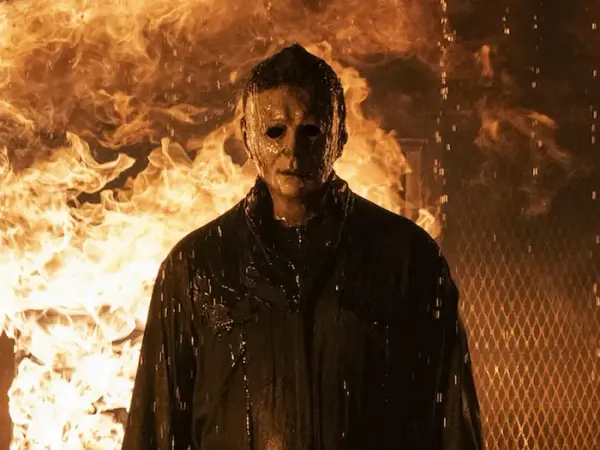
The finale has fire, weapons, three generations of Strode women, and the kind of elaborate confrontation the movie has been promising since its opening scenes. It should be enormously satisfying. For me, it never quite is. I can admire individual moments without feeling the full emotional impact the filmmakers are aiming for. Even Laurie’s “Happy Halloween, Michael” doesn’t land with the same outrageous energy as Busta Rhymes announcing “Trick or treat, motherfucker” in Resurrection. I realize that is not a comparison the filmmakers were hoping anyone would make.
A Familiar Theme, a Different Pumpkin
One element I’m delighted to have back is John Carpenter’s musical involvement. Carpenter worked on the score with Cody Carpenter and Daniel Davies, and the familiar theme immediately connects the movie to its origins. The opening credits make that connection explicit with a clever reversal: instead of watching a jack-o’-lantern decay, we see a collapsed pumpkin seemingly come back to life. It’s a simple image, and I like it considerably more than some of the screenplay’s more elaborate attempts to revive the franchise.
That may be the best way to describe my relationship with Halloween (2018). When it trusts a recognizable image, an effective scare, or a good actor to carry a scene, I’m usually on board. When it tries to justify its new mythology, manufacture emotional history, or force the pieces into place for a big finale, I start noticing the machinery. The movie wants the freedom of ignoring the sequels and the emotional weight of continuing them. It doesn’t always manage to have both.
Forty Years Later
I wouldn’t necessarily say I dislike Halloween (2018). That may sound like faint praise after all this complaining, but I mean it. I genuinely enjoy some scenes, appreciate some performances, and would happily revisit a handful of moments. Curtis is always worth watching as Laurie, even when I prefer another version of the character. Patton adds substance, Greer delivers a wonderful payoff, and Gardner and her fellow babysitting-house occupants briefly steal the movie. Also, Michael can still be frightening when the filmmakers give him room to be.
What I can’t shake is the feeling that I’ve already seen a more emotionally persuasive version of Laurie’s return in H20. This movie is bigger, louder, and more determined to make her a warrior. I’m just not sure it understands her any better. Forty years after the original, Halloween has once again decided that the best way forward is to go backward. Sometimes that approach works remarkably well, but other times it feels like this franchise is still trying to figure out what it wants to be when it grows up.
THE FIXATION SCALE
★★½☆☆
2½ out of 4