Franchise Fixation: Halloween H20: 20 Years Later (1998)
Twenty years later, Laurie Strode returns. Twenty-eight years later, I finally appreciate it.

I hated Halloween H20 when I saw it in a theater in 1998. “Hated” might be strong, but it’s the word I remember. I walked in excited about Jamie Lee Curtis returning to the franchise, and I walked out wondering why a movie celebrating twenty years of John Carpenter’s Halloween felt so determined to be part of a different slasher franchise. I wanted a closer return to the original film, but what I got was a film that seemed awfully interested in being Scream. Let me be clear: I love Scream, and I was really excited that Kevin Williamson was involved, in any capacity, in bringing Laurie Strode and Michael Myers back to the big screen, but I didn’t want it to feel like it could just as easily have been a storyline for Scream 3.
Here’s the strange part: I like it now. I’m not sure another installment in this franchise has improved for me as much with repeated viewings. Most of what bothered me in 1998 still bothers me. The mask is a problem. The teenagers sometimes seem to have wandered in from another movie. There are stretches where the story stops to fool around when it ought to be tightening the screws. None of that has magically disappeared.
What’s changed is how much I appreciate what H20 does right. Maybe watching what happens in the next movie helped put things into perspective. That’s not exactly a ringing endorsement, I realize. More importantly, I think I was so busy judging this movie against the Halloween I wanted that I didn’t give enough credit to the Halloween that was actually on the screen. Jamie Lee Curtis is excellent. Laurie Strode is finally the center of a story worth telling about her. Michael Myers feels dangerous again. And that last act? It’s terrific.
At about 86 minutes, H20 is remarkably economical. It also has the distinction of being the first Michael Myers sequel to look at several earlier installments and essentially say, “No, thank you.” If you’ve been following Franchise Fixation in release order, you can probably understand the temptation.
The Timeline Has Left the Building
Let’s sort out what counts this time. Halloween H20 follows the events of Halloween and Halloween II. Halloween 4: The Return of Michael Myers, Halloween 5: The Revenge of Michael Myers, and Halloween: The Curse of Michael Myers no longer figure into the story. The Thorn cult, Jamie Lloyd, and all the increasingly complicated explanations for Michael’s behavior have been shown the door. Technically, Halloween III already showed that the series could go somewhere entirely different, but this is our first major reset of Michael Myers’ story.
Instead, Laurie Strode is alive. She faked her death, left Illinois, changed her name to Keri Tate, and became the headmistress of a private school in California. She has a teenage son, John, and has spent two decades trying to build a life that Michael Myers can’t find. Unfortunately, escaping Haddonfield doesn’t mean escaping what happened there. Laurie drinks too much, has nightmares, and lives with the knowledge that her brother might come back. This film does follow the events of Part II, where Michael Myers appeared to be burnt to death in a hospital explosion, but no body was ever found.
There are obvious questions if they had chosen to keep 4-6 in the continuity. If Laurie was alive all this time, what exactly are we supposed to do with the daughter she had in the previous films? Could we, as an audience, root for a protagonist who had abandoned her child, making her think she had died in a car crash? How did that family history fit with a son who’s now seventeen? The answer is that it doesn’t. H20 isn’t interested in building an elaborate bridge from the Thorn trilogy to this movie. I’m not convinced a bridge worth crossing could have been built, especially after Donald Pleasence’s death deprived the series of Dr. Loomis. In this case, simplifying the continuity is a creative advantage.
That doesn’t mean I want every franchise to erase the parts it finds inconvenient. If anything, Halloween will eventually make it an unfortunate habit. Still, this movie is about Laurie, and bringing her back means giving her a coherent emotional history. Watching her confront the trauma of the first two movies is more compelling than explaining how the Cult of Thorn fits into her new life. I’m willing to make that trade.
Twenty Years, One Very Successful Scream
You can’t talk about H20 without talking about the aforementioned Scream. Wes Craven’s 1996 hit didn’t just revive interest in theatrical slashers; it changed what studios thought a slasher should sound and look like. Suddenly everyone wanted attractive young actors, knowing dialogue, a glossy presentation, and a story that could acknowledge horror conventions without appearing embarrassed by them. Halloween had helped create the commercial template for the slasher boom. Twenty years later, the franchise was taking notes from a movie that had taken notes from Halloween.
The path to this particular sequel was complicated. Daniel Farrands, who wrote The Curse of Michael Myers, had ideas for continuing that film’s mythology, including a larger Haddonfield conspiracy. Another proposed direction involved Kevin Williamson, whose success with Scream made him an obvious person to approach. Williamson contributed a treatment, while Robert Zappia and Matt Greenberg received the screenplay credit. The precise division of ideas and later revisions is one of those production histories that gets less clear the more versions you hear.
John Carpenter’s name was also floated as a possible director. Accounts of those discussions include a reported $10 million fee that the producers weren’t willing to pay. Whatever the negotiations involved, Carpenter didn’t return. Steve Miner took the job instead. Miner had directed Friday the 13th Part 2 and Friday the 13th Part III, along with a few other genre pictures. He knew how to make a horror movie, even if he wasn’t going to shoot one like Carpenter.
The Scream influence is most obvious whenever the movie turns its attention to John (Josh Hartnett) and his friends. They’re appealing young performers delivering banter in the recognizable rhythm of late-1990s teen horror. That doesn’t make the dialogue bad, and I actually enjoy a fair amount of it. The problem is that the movie occasionally feels like it’s borrowed a group of characters from the wrong franchise. Carpenter’s teenagers in 1978 were interesting because they seemed ordinary. These teenagers have that “we know we’re in a movie” meta-sheen that was already getting a little stale two years after Scream’s release.
There were reportedly even concepts involving a copycat killer, with one version pointing toward Charlie, the character Adam Hann-Byrd eventually played. I could never express how much joy I feel that they didn’t take that route. I love a good whodunit slasher. Movies like Happy Birthday to Me, 1986’s April Fool’s Day, and, of course, most of the Scream franchise are some of my favorites, but that’s not what Halloween is, and it never needed to be.
Laurie Strode Is Still Here
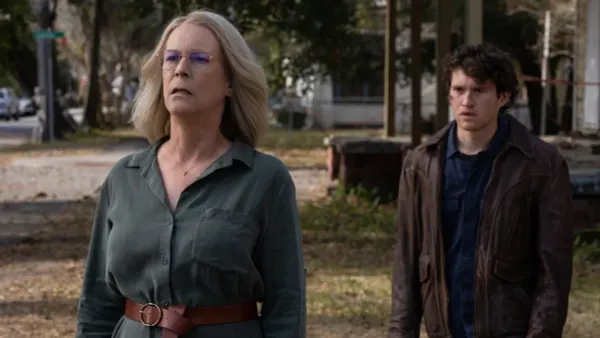
H20's strongest decision is to treat Laurie’s survival as more complicated than a triumphant return. Jamie Lee Curtis doesn’t play her as the confident action heroine she’ll sometimes become in later versions of this story. Laurie has built a respectable life, but it’s built on fear. She runs a school. She has a boyfriend. She has a son who loves her, even if he’s exhausted by the rules she imposes on him. She can function. She just can’t relax.
There’s a small moment that tells us almost everything. At a restaurant, Laurie asks for another glass of wine while the one in front of her is still full. It’s funny for about half a second, and then you realize what it says about her. This is someone who has spent twenty years trying to turn down the volume in her own head. Her conversations with Will (Adam Arkin), a school employee and Laurie’s current boyfriend, reveal more of the damage without turning the film into an extended therapy session. Curtis knows when to let Laurie’s anxiety show and when to keep it barely beneath the surface.
John, played by Josh Hartnett (and to some extent Josh Hartnett’s hair) in his feature-film debut, has grown up with that anxiety as a permanent third person in the room. His mother’s rules are suffocating, but the audience knows why they exist. I like that H20 doesn’t ask us to choose one side. Laurie has good reason to be terrified. John has good reason to want a normal adolescence. Michael’s eventual arrival proves Laurie right without making all the years John spent living under her fear any less real.
Hartnett is good here. Michelle Williams plays his girlfriend Molly and gives her a warmth that makes their relationship feel like more than a collection of teenage-horror beats. Jodi Lyn O’Keefe and Adam Hann-Byrd are also perfectly capable in their roles as Sarah and Charlie. I just wish the script had given the group something more interesting to do than sneak off for a little Halloween celebration. Their scenes aren’t disastrous; they’re simply less compelling than nearly anything involving Laurie.
The film’s best relationship, though, might be one that lasts only a few minutes. Janet Leigh appears as Norma, Keri/Laurie’s assistant, and shares a lovely scene with Curtis. Yes, it’s an enormous Psycho reference. Norma’s name is a giveaway; the music underlines it, and the car she drives away in practically waves at the audience. None of that bothers me. Leigh and Curtis are of course mother and daughter in real life, and the scene uses that connection for something genuinely sweet. Norma offers Keri/Laurie the kind of reassuring, motherly advice she badly needs. It’s fan service, absolutely, but it’s fan service with a pulse.
California, Not Haddonfield
H20 makes another clean break by moving the action away from Haddonfield altogether. As far as I can recall, it’s the only entry in this franchise that never actually visits the town. We open with a connection to Laurie’s old life, but the main story unfolds around the secluded California school where she works. It’s a smart location in practical terms. The campus can be emptied for the holiday, leaving a handful of people in a place full of dark corridors, locked gates, and rooms where Michael might be waiting.
I’m less convinced the setting gives the film an identity of its own. Haddonfield in the original Halloween was terrifying precisely because it looked like a neighborhood where nothing terrible ought to happen. The school in H20 looks like the kind of location where a horror movie is supposed to happen. It’s attractive, cinematic, and convenient, but it never becomes a character the way those suburban streets did.
The opening sequence at least gives us a fun connection to the older movies. Nancy Stephens returns as Marion Chambers, a familiar face from Halloween and Halloween II, and Joseph Gordon-Levitt turns up as a young neighbor. It’s nice to see Marion again, although I wish the movie had found a better reason to bring her back than making her the first major victim. She gives us a tangible connection to Loomis and the earlier films before H20 moves on to Laurie’s new world.
Then there’s the rest-stop sequence, which is the kind of material that frustrates me more with each viewing. Michael needs transportation. We spend time watching him acquire it, but without a memorable kill or much suspense to justify the detour. In a film this short, every scene should earn its place. I can accept a movie taking its time if it’s creating atmosphere. This scene mostly seems to be moving a vehicle from one part of the plot to another.
The Shape, With a Few Different Faces
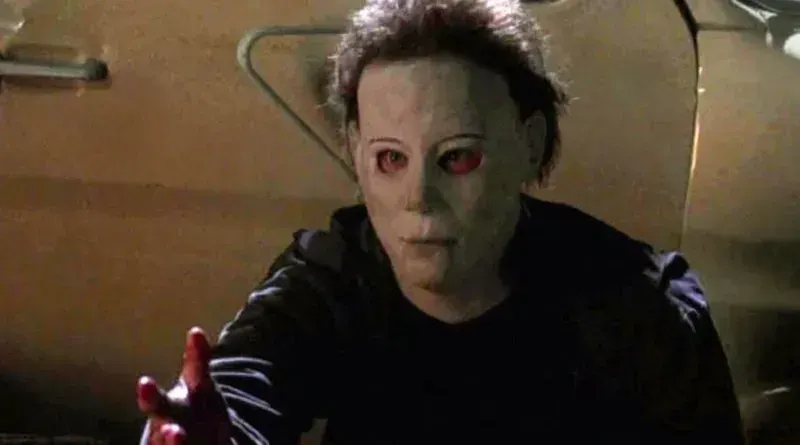
One of my complaints in 1998 was Michael himself. Not his behavior, which I’ve grown to like, but his appearance. Once again, this franchise has found a way to make a simple white mask into a complicated production problem. Different masks appear throughout the film, and there’s even a notorious digitally altered shot. Once you notice the differences, you may spend more time than you’d like studying Michael’s face instead of being frightened by it.
I still don’t understand how the series could repeatedly struggle with one of its most recognizable visual elements. Carpenter and Tommy Lee Wallace turned a cheap Captain Kirk mask into something iconic in 1978. Twenty years and several sequels later, we’re apparently still trying to figure out what Michael Myers should look like. Some of H20’s versions have eyes that are far too visible, and that alone changes the character.
Still, Michael is more imposing here than he’s been in a while. H20 largely abandons the mythology that turned him into a participant in a supernatural family conspiracy. He’s after Laurie. That’s it. He moves with purpose and isn’t particularly interested in explaining himself. The movie gives him a directness that I missed in the previous installments.
I wouldn’t call H20 particularly scary. Miner knows how to stage an effective pursuit and build a sequence around physical space, but he isn’t the suspense magician Carpenter was in 1978. To be fair, he’s not trying to be either. This is a more straightforward, polished late-1990s slasher, and it’s often very entertaining on those terms. At times, Michael feels less like a ghost haunting the frame and more like a relentless attacker. That’s a different kind of threat, but it works well enough when Laurie finally stops running.
Who Gets to Die on Camera?
There’s one element of H20 that has always bothered me, and it’s become harder to ignore as I’ve revisited the movie. Look at how it handles its victims. Most of the male characters who die are dispatched offscreen. Will’s death is visible, but it’s a relatively quick stabbing. Meanwhile, the two prominent female victims, Marion and Sarah, are subjected to much more elaborate sequences of suffering.
Sarah’s death is especially nasty. In her initial attempt to get away from Michael, her leg is severely broken and crushed by a dumbwaiter, and we’re forced to watch her struggle to escape while barely able to move. He eventually catches and stabs her repeatedly, and later John and Molly find her body displayed like some grotesque Halloween decoration. The film lingers on her vulnerability in a way it generally doesn’t with the men.
I’m not claiming the filmmakers sat down and decided that women deserved more painful deaths. Slashers have always had a complicated relationship with the bodies they put in danger, and the genre often reserves its most elaborate set pieces for characters who happen to be women. The distinction here is simply difficult not to notice. There aren’t that many deaths to begin with, and if the movie is going to be ruthless, why does that ruthlessness fall so unevenly?
It’s worth mentioning because this isn’t a complaint that disappears just because I’ve grown to enjoy the film. If anything, I’m more aware of it now. H20 wants us to cheer for Laurie’s ability to survive and reclaim her life. That’s a good instinct. I wish the movie had been a little more thoughtful about what it asks us to watch the other women endure along the way.
Ronny, Romance Novels, and an Unnecessary Detour
LL Cool J plays Ronny, the school security guard, and he’s fine. He has an easygoing presence, and the movie clearly enjoys having him around. His running conversations with his girlfriend about the romance novel he’s writing are meant to be a little comic relief. I’m not opposed to comic relief in Halloween. Donald Pleasence got laughs in the original movie just by frightening a kid near a hedge and looking pleased with himself.
The trouble is that Ronny’s writing subplot never becomes particularly funny or revealing. It’s a bit that keeps coming back, and every time it does, I’m reminded that this movie is only 86 minutes long. We have Laurie Strode confronting twenty years of trauma and Michael Myers closing in on her. Do we really need another excerpt from Ronny’s manuscript?
He has a more interesting use later in the film. Will accidentally shoots Ronny after mistaking him for Michael, a moment that could have introduced a grim consequence to everyone’s panic. Before the film can explore much of that, Michael appears and kills Will. Ronny survives, and the story moves on. I’ve sometimes wondered whether keeping him alive was a late decision, although I don’t have evidence for that. What I do know is that the false alarm creates a genuinely interesting beat, and the movie doesn’t do very much with it.
The Last Twenty Minutes
Everything changes once Laurie decides she’s finished running. Up to that point, H20 has been an uneven but enjoyable late-1990s slasher with a particularly good lead performance. Once Laurie sends the others away and turns back toward the school, it becomes the movie I wish it had been the whole time.
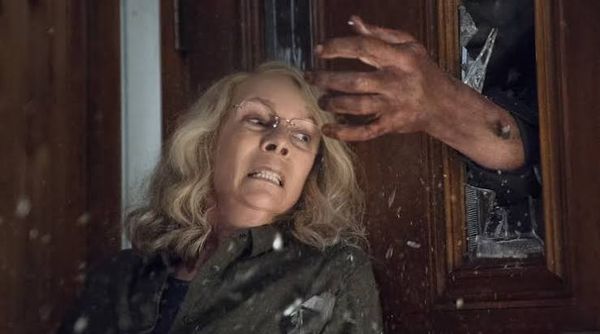
The image of Laurie and Michael facing each other through the window in the door is one of the great shots in this franchise. After twenty years, there they are. The woman who survived and the man who never stopped coming. No cult explanation. No complicated mythology. No speech about destiny. Just two people looking at each other through a pane of glass, and all the history we’ve brought into the theater with us. That shot works because the movie finally understands the power of simplicity. Michael doesn’t need a new backstory. Laurie doesn’t need to explain why she’s afraid. We know. We watched it happen in 1978 and 1981. More importantly, Curtis makes us believe Laurie has been carrying those nights with her every day since.
What follows is a wonderfully energetic confrontation. Laurie fights with the desperation of someone who knows exactly what Michael can do, but she also fights with a determination she didn’t possess at seventeen. The geography is clear, the attacks have weight, and Miner lets the two characters occupy the same space long enough for the encounters to matter. It isn’t Carpenter’s brand of creeping dread, but it’s satisfying filmmaking.
Then H20 makes the decision that elevates the entire movie. Laurie doesn’t wait for the authorities to assure her Michael is dead. She takes the vehicle carrying his body, drives away, and finishes the job herself. When he reaches toward her, she pauses. For a moment, something almost human flickers in the gesture, as if the movie dares her to hesitate. Laurie doesn’t. She swings the axe and takes his head off.
Cut to the credits. The Halloween theme kicks in. Beautiful.
I know what the next movie will tell us. I know how this ending gets rewritten, and I know they were already planning the explanation around the time H20 was made. We’ll deal with that when we get to Halloween: Resurrection, and I promise I’ll have plenty to say. However, I refuse to let a later sequel completely ruin the ending of this one. Judged on its own terms, it’s a hell of a final shot and an almost perfect way to end Laurie’s story.
A Better Movie Than I Remembered
I’m not going to pretend Halloween H20 is a masterpiece just because I’ve softened toward it. It still looks and sounds too much like the post-Scream wave of slashers. Its teenage characters are more appealing than their storylines. The mask remains an inexplicable mess. The film takes detours that it doesn’t need, and its treatment of a couple of victims leaves a sour taste. Also, let’s be honest, that title is terrible. The “H20” part will always read like “Halloween: Water,” and the “20 Years Later” sounds like it belongs on a famous novel’s anniversary reprint more than it does on a movie poster.
Yet I’ve come to appreciate how much the movie gets right. It has a clear emotional reason to exist. Jamie Lee Curtis doesn’t simply return so the poster can advertise her name; she gives us a Laurie Strode who has lived with the consequences of surviving. Josh Hartnett and the supporting cast do solid work. Janet Leigh’s brief appearance adds a little warmth. Michael has lost most of the baggage the franchise piled onto him, and the climax finally gives Laurie the confrontation she deserves.
Maybe that’s why my feelings have changed. In 1998 I saw everything H20 wasn’t. It wasn’t Carpenter. It wasn’t 1978. It wasn’t the Halloween sequel I’d been imagining. Today I’m more interested in what it is: a brisk, entertaining slasher with a surprisingly thoughtful center and an ending that understands exactly what its audience has been waiting twenty years to see.
There’s a version of this story where the franchise stops here. Laurie survives, confronts the thing that destroyed her life, and makes sure it can’t follow her anymore. After everything we’ve been through in these first seven movies, that would have been a pretty satisfying place to leave Michael Myers.
Of course, there was money to be made. We all know what that means.
THE FIXATION SCALE
★★★☆
3 out of 4