Franchise Fixation: Halloween: The Curse of Michael Myers (1995)
Six years after Halloween 5, Michael Myers returns with a new mythology, a troubled production, and Donald Pleasence's final appearance as Dr. Loomis. The Curse of Michael Myers delivers plenty of Halloween atmosphere, but does it deliver any satisfying answers?

I was genuinely excited when Halloween: The Curse of Michael Myers was announced. This would be the first Halloween movie I saw in a theater. I was 19 when it finally arrived, and I had spent nearly six years wondering who the hell the Man in Black was and why he had broken Michael Myers out of jail. I wanted to see where Jamie Lloyd's story would go. I wanted more Dr. Loomis in my life. Most of all, I wanted the series to reward the patience of those of us who had stuck with it through Halloween 5 and its maddening cliffhanger.
I saw The Curse of Michael Myers on opening night. By the time I walked out, I had learned an important lesson about the dangers of asking a franchise to explain itself. Sometimes the mystery really is better than the answer. In this case, the answer involved ancient runes, a secret society, a baby, and a screenplay that seems determined to include every idea anyone had during the six years it took to make the movie.
There is an odd kind of ambition here that I can appreciate. After Halloween 5 introduced a mysterious stranger, a symbol on Michael's wrist, and a psychic connection with Jamie with little interest in explaining any of it, this sequel at least tries to make those things part of a coherent mythology. Unfortunately, connecting the dots and producing a story that makes sense are two very different accomplishments.
A Homecoming Without a Home
The story returns to Haddonfield, where Halloween has apparently become such a source of trauma that the town has avoided celebrating it for years. Meanwhile, another family named Strode now occupies the Myers house, unrelated to Laurie and her adoptive parents. John Strode (Bradford English) knows the home's history, but somehow the rest of his family seems oblivious. This is a town where Michael Myers is practically the reason Halloween has been canceled. It's hard to swallow that the most notorious house in Haddonfield could become just another property on the market without anyone noticing.
The Strode family supplies most of the movie's potential victims. The family includes John's wife, Debra (Kim Darby); their daughter, Kara (Marianne Hagan); Kara's young son, Danny (Devin Gardner); and Kara's brother, Tim (Keith Bogart), along with his girlfriend, Beth (Mariah O'Brien). Few have much personality beyond broad character types, and their motivations shift whenever the plot needs them to. John is so unpleasant that his scenes seem designed less to establish a person than to make the audience anticipate his death.
Kara is nominally one of our leads, but the movie never makes a compelling case for why she and her family need to be at the center of this story. Danny has visions and seems to have some sort of connection to Michael, an idea that immediately recalls Jamie's psychic link in Halloween 5. Is Danny being groomed as Michael's successor? Is he receiving supernatural messages? Is he simply another child the cult has targeted? The movie raises these possibilities and then treats them as if they're interchangeable. By the end, I'm not sure the film knows what Danny is supposed to be.
The one returning child from the franchise who absolutely should matter is Jamie Lloyd. Instead, Jamie, now played by J. C. Brandy, is introduced as a captive who has given birth and is trying to escape with her baby. Michael catches up with her at a barn, where she suffers possibly the most violent death in the franchise at this point; it involves farm machinery. After Halloween 5 discarded Rachel so brutally, I never imagined the next sequel could find an even uglier way to dispose of a character audiences had followed for years. Yet here we are. Jamie was the emotional center of the previous two films, and her connection to Michael was central to the mystery this sequel supposedly tries to resolve. Instead of giving her a meaningful role in that resolution, the filmmakers reduce her to a plot device whose only real purpose is to deliver a baby before being removed from the story entirely.
Tommy Doyle, Dr. Loomis, and the Last Return
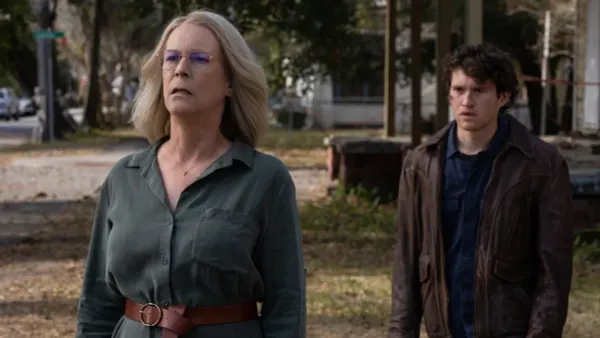
The movie does have a more interesting route into its mythology: Tommy Doyle, the boy Laurie Strode babysat in John Carpenter's original film, has grown into a young man obsessed with Michael Myers. Paul Rudd, credited here as Paul Stephen Rudd, makes his feature-film debut in the role (though Clueless, which he shot later, actually released a couple of months before this). Given the material, he's actually pretty good. His nervous intensity is an understandable response to a childhood encounter with a killer who apparently cannot be stopped, even if some of Tommy's dialogue sounds like it was assembled from a collection of conspiracy theories.
Tommy has been watching for Michael's return and studying the mysterious thorn symbol associated with him. He also finds himself drawn into the Strode family's troubles. Tommy should have been the backbone of this movie, carrying the psychological scars of 1978 and joining Loomis in one last effort to understand and stop Michael. Instead, the film keeps wandering away from its most compelling characters to service a family subplot that adds little beyond another set of bodies.
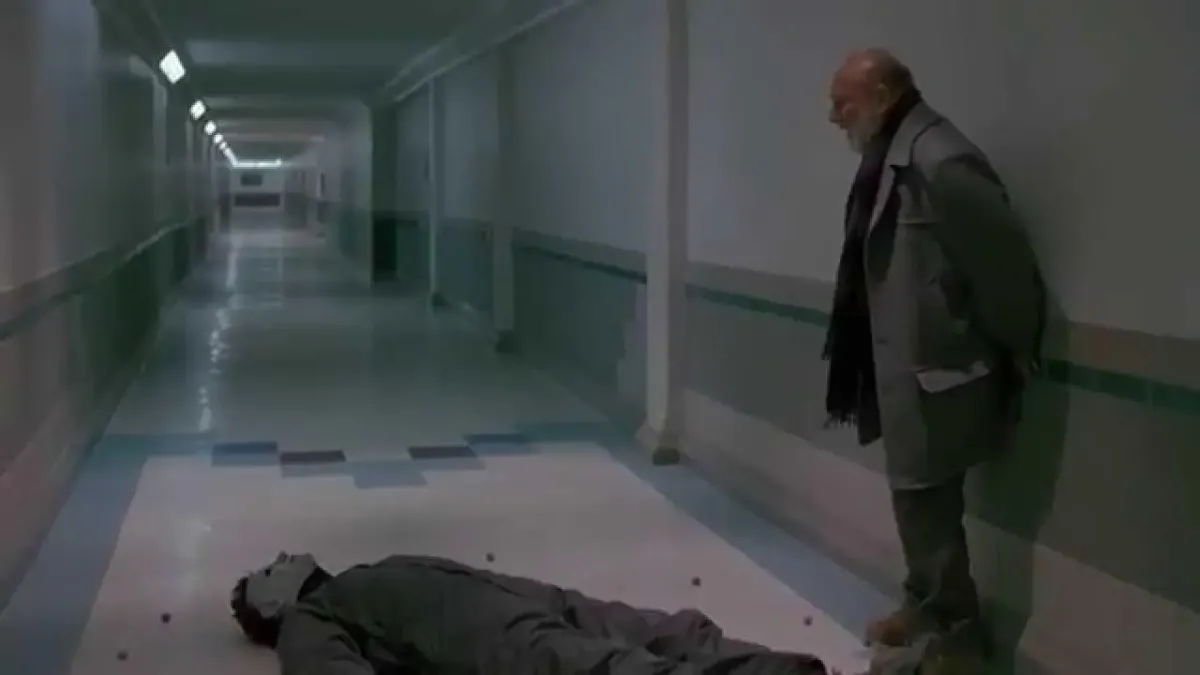
Donald Pleasence's final appearance as Dr. Loomis is both welcome and difficult to watch. He looks frail, and the frantic energy that defined some of his later performances is largely gone. I actually like the more subdued Loomis here. After everything he's endured, a weary, diminished version of him feels entirely plausible. At the same time, knowing this was Pleasence's final film makes even his quieter scenes sad. The series never quite knew what to do with Loomis beyond having him warn people about evil, but Pleasence always made those warnings feel like matters of life and death.
It's especially frustrating that Loomis disappears for so much of the film's latter half. A story that promises to resolve the mystery of Michael Myers should give the person who spent his life pursuing Michael a meaningful role in that resolution. Instead, Loomis often seems to watch the plot unfold from the sidelines. To be fair, Pleasence isn't in large portions of the movie for very specific reasons, and we will get to that shortly.
The Best Halloween Atmosphere in a Bad Halloween Movie
Here is where I have to give the film genuine credit: it might be the most aggressively autumnal installment in the entire franchise. Haddonfield looks and feels like a place in mid-October. The decorations, leaves, neighborhood streets, holiday imagery, and sense of a town defined by Halloween all appeal to me. For a franchise that sometimes seems to forget its own title, The Curse of Michael Myers understands the season's value.
That atmosphere is a big part of why I can understand someone wanting to revisit it every October, and honestly why I have more than I should. Individual images and stretches of mood suggest a much better movie lurking somewhere in the footage. If only the filmmakers had let those moments breathe.
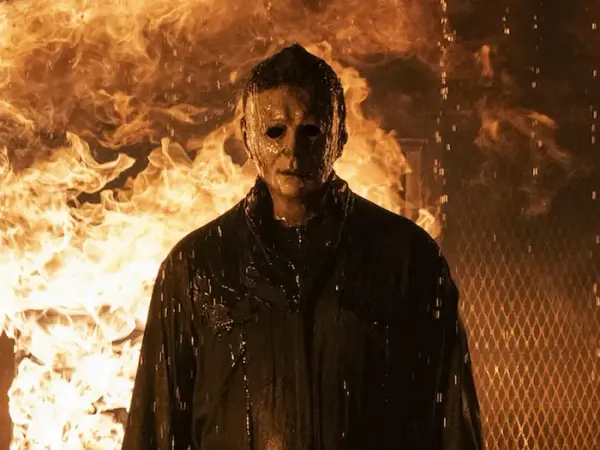
Instead, director Joe Chappelle's finished film often feels edited like a mid-1990s music video. The cuts are rapid, the images are distorted, and the sound and score often push aggression over suspense. Michael's stalking scenes don't build the dreadful anticipation that made the original film so effective; they rush toward the next burst of violence. The movie has a lot of plot, yet it can feel strangely uninterested in developing it because it is too busy getting to the next kill.
Even the geography of Michael's killing spree becomes absurd. He returns to his childhood home to kill Debra, reappears when John gets home, turns up in radio host Barry Simms's van what feels like moments later, and then is right back at the house for Tim and Beth. I can accept that Michael has an almost supernatural ability to appear where he shouldn't; that’s been part of the franchise for years. What I can't accept is a series of scenes that make it seem like nobody has bothered to ask where he is, what he wants, or why he's chosen this particular victim at this particular moment.
For all its theatrical ambitions, the film often resembles the kind of inexpensive, mythology-heavy sequel that might have appeared on video under the Children of the Corn banner during the same period, or in future Hellraiser installments. The comparison isn't about the cult; it's about the cheap-looking execution, anonymous supporting characters, and a story that keeps substituting exposition and carnage for tension.
The Thorn Problem
To answer what the hell that Halloween 5 cliffhanger was all about, we eventually learn that Michael is bound to the Cult of Thorn, a secret group tied to an ancient curse and a sacrificial cycle. It's an absolutely ridiculous direction for a series that began with an escaped patient silently stalking a suburban neighborhood. Still, I have to admit there is something perversely charming about how seriously the filmmakers take explaining the unexplained. They didn't simply ignore the Man in Black or pretend Halloween 5 never happened; they built an entire occult conspiracy around its loose ends.
The Man in Black is Dr. Wynn (Mitchell Ryan), a figure with roots in the original Halloween. Wynn is the Smith's Grove doctor who insists that Michael cannot possibly drive a car, prompting Loomis to wonder whether someone gave him lessons. Bringing that minor character back as the leader of a conspiracy is exactly the sort of deep-cut continuity choice I ought to enjoy. On paper, it's a fun way to make the franchise's past matter.
Onscreen, however, it raises more questions than it answers. Wynn wants Loomis back at Smith's Grove, even though the institution is apparently studying, manipulating, or trying to harness Michael's evil. Has Wynn somehow forgotten that Loomis is the least likely person on Earth to cooperate with such a project? Is Michael killing the Strodes because the cult has ordered him to? Is he after Jamie's baby because of the curse? How much of what he does is his own will? The film gestures toward answers without settling on a consistent set of rules.
Then Michael begins slaughtering the Smith's Grove personnel, and the movie never adequately explains why the cult's control has suddenly failed. This is supposed to be the payoff to six years of mystery, but it plays like the screenwriters decided to stop answering questions just as the audience was finally entitled to some answers. I don't necessarily need Michael Myers explained. In fact, I generally prefer him unexplained. Once a film chooses to explain him, though, it has an obligation to make its explanation intelligible.
A Production as Fractured as the Film
The story behind The Curse of Michael Myers helps explain why the finished film feels so unstable. Screenwriter Daniel Farrands developed an elaborate approach to the series' continuity, drawing on earlier films and related material. The project went through a lengthy development process, creative personnel changes, and was eventually produced under the Dimension banner, owned by Miramax Films. Joe Chappelle directed the film, but an unsuccessful test screening led to extensive reworking and reshoots.
The results are visible. The movie can shift from one mode to another within a single sequence: supernatural mythology, family melodrama, slasher violence, medical experimentation, and a frantic chase through Smith's Grove. Even Michael changes appearance at times because additional photography used a different performer than George P. Wilbur, who played him in the main shoot. The problem isn't that the film has too many ideas; the problem is that the scenes rarely feel like they belong to the same story.
Pleasence died before the reshoots, further limiting what the filmmakers could do with Loomis in the revised material. His absence is particularly noticeable in the last act. That loss was beyond the filmmakers' control, of course, and it makes the production's troubled history feel more poignant than amusing. The franchise tried to move forward after losing the performer who had been its most dependable link to the original film.
Two Cuts, Two Different Problems
The theatrical release isn't the only version of Halloween 6. An earlier assembly, now widely known as the Producer's Cut, circulated among fans for years before receiving an official release. It isn't merely the theatrical movie with a few deleted scenes put back. It has different music, additional character material, and a substantially different conclusion.
The Producer's Cut gives Loomis more screen time and even puts his narration over the opening, where the theatrical version uses Tommy. Its score leans more heavily toward the sound of the earlier Halloween films, and it largely avoids the frantic montage style that makes the theatrical cut so exhausting. Jamie survives the barn attack in this version, only to be murdered later in the hospital by Wynn. That is still a lousy end for Jamie, but at least the film doesn't dispose of her quite so casually in its opening minutes.
The biggest difference is the climax. In the Producer's Cut, the cult's ceremony and its plan for Danny are much more explicit. Tommy uses runes to immobilize Michael, and Loomis discovers that Michael has escaped by switching clothes with Wynn. The dying Wynn passes the Thorn mark to Loomis, implying that Loomis has inherited his role. The theatrical version abandons that resolution for a more violent hospital confrontation in which Tommy injects Michael and beats him with a pipe. The final image is Michael's abandoned mask, with Loomis screaming offscreen.
Neither ending works for me. The Producer's Cut is clearer about what the cult wants, but it also commits more fully to supernatural rules that diminish Michael Myers' unsettling simplicity. It also leans into the especially ugly implication that Michael himself fathered Jamie's baby, turning an already disturbing storyline into something even more unpleasant. The theatrical ending offers more action, and a pretty great Brother Cane song, but so little explanation that it barely feels like an ending. Watching the two versions is a fascinating exercise in how a movie can go wrong in different directions. Neither solves the fundamental problem: the story needed a much clearer center.
The Curse That Never Quite Lifts
I know you’re supposed to critique the movie in front of you, not the movie that could have been, but I can imagine a version of it I'd like. It would have followed Tommy and Loomis, perhaps with Jamie still alive, as they tried to uncover the people who had been protecting Michael. It would have made Haddonfield's long memory of Halloween central to the mystery. It could even have kept the Cult of Thorn, provided the cult served a focused story instead of swallowing the entire film.
What we got is a movie with wonderful seasonal texture, one last affecting performance from Donald Pleasence, and an admirably stubborn desire to tie up the franchise's loose ends. Those are real virtues. They're simply buried beneath flat characters, incoherent motivations, abrupt editing, and a third act that seems to change the rules every few minutes. Halloween 5 was frustrating because it set up mysteries without knowing where they were going. The Curse of Michael Myers is frustrating because it finally tries to answer them and somehow makes the situation even more confusing.
One thing I genuinely love about this franchise is that this movie has its defenders. I don't understand them, but I'm glad they exist. The continuing popularity of The Curse of Michael Myers among fans both confounds me and makes me smile. There's something endearing about a series that can inspire fierce affection even for an installment I find almost impossible to defend. Perhaps some fans respond to the atmosphere, others to the audacity of the mythology, and others to the very messiness that drives me up the wall. Whatever the reason, I'm happy the movie has found its audience, even if I won't be joining them.
This might not be the worst Halloween sequel, but it may be the franchise's biggest head-scratcher. After six years of waiting to learn who the Man in Black was, I left the theater wishing the series had left the question unanswered.
THE FIXATION SCALE
★½☆☆☆
1½ out of 4 (Both cuts)